Dear Brothers and Sisters in Rome and throughout the world, and all men and women, Whom the Lord loves!
"Lux fulgebit hodie super nos,
quia natus est nobis Dominus.
A light will shine on us this day,
The Lord is born for us "
(Roman Missal, Christmas, Entrance Antiphon for the Mass at Dawn)
The liturgy of the Mass at Dawn reminded us that the night is now past, the day has begun, the light radiating from the cave of Bethlehem shines upon us.
The Bible and the Liturgy do not, however, speak to us about a natural light, but a different, special light, which is somehow directed to and focused upon "us," the same "us" For Whom the Child of Bethlehem "is born. This "us" is the Church, the great universal family of those who believe in Christ, who have awaited in hope the new birth of the Savior, and who today celebrated in the perennial mystery significance of this event.
At first, beside the manger in Bethlehem, that "us" was almost imperceptible to human eyes. As the Gospel of Saint Luke recounts, it included, in addition to Mary and Joseph, a few lowly shepherds who came to the cave after hearing the message of the Angels. The light of that first Christmas was like a fire kindled in the night. All about there was darkness, while in the cave there shone the true light "that enlightens every man" (Jn 1:9). And yet all this took place in simplicity and hiddenness, in the way that God works in all of salvation history. God loves to light Little lights, so as then to vast lit spaces. Truth and Love, Which are its content, are kindled wherever the light is welcomed, they then radiated in concentric circles, as if by contact, in the hearts and minds of all those who, by opening themselves freely to its splendor, themselves become sources of light. Such is the history of the Church: She Began her journey in the lowly cave of Bethlehem, and down the centuries she has become a People and a source of light for Humanity. Today too, in those who encounter that Child, God still kindles fires in the night of the world, calling men and women everywhere to acknowledge in Jesus the "sign" of his saving and Liberating presence and to extend the "us" of those who Believe in Christ to the whole of mankind.
Wherever there is an "us" which welcomes God's love, there the light of Christ shines forth, even in the most difficult situations. The Church, like the Virgin Mary, offers the World Jesus, the Son, Whom she herself has received as a gift, the One who came to set mankind free from the slavery of sin. Like Mary, the Church does not fear, for that Child is her strength. But she does not keep him for herself: she offers him to all those who seek him with a sincere heart, to the earth's lowly and Afflicted, to the victims of violence, and to all who yearn for peace. Today too, on Behalf of a human family profoundly affected by a severe financial crisis, yet even more by a moral crisis, and by the painful wounds of wars and conflicts, the Church, faithful in solidarity with mankind, repeats with the shepherds: " Let us go to Bethlehem "(Lk 2:15), for there we shall find our hope.
The "us" of the Church is alive in the place where Jesus was born, in the Holy Land, inviting people to abandon its every logic of violence and vengeance, and to engage with renewed vigor and generosity in the process Which leads to peaceful coexistence . The "us" of the Church is present in the other countries of the Middle East. How can we forget the troubled situation in Iraq and the "little flock" of Christians Which lives in the region? At times it is subject to violence and injustice, but it remains determined to make its own contribution to the building of a society opposed to the logic of conflict and the rejection of one's neighbor. The "us" of the Church is active in Sri Lanka, in the Korean peninsula and in the Philippines, as well as in the other countries of Asia, as a Leaven of reconciliation and peace. On the continent of Africa she does not cease to lift her voice to God, imploring an end to every injustice in the Democratic Republic of Congo, she invites the citizens of Guinea and Niger to respect for the rights of every person and to dialogue, she Those of Madagascar begs to overcome their internal divisions and to Be Mutually accepting, and she reminds all men and women that they are called to hope, despite the tragedies, trials and difficulties Which Still Afflict them. In Europe and North America, the "us" of the Church urges people to leave behind the technicist and selfish mentality, to advance the common good and to show respect for the persons who are most Defenseless, starting with the unborn. In Honduras she is assisting in the process of rebuilding institutions; throughout Latin America, the "us" of the Church is a source of identity, a fullness of truth and of charity Which ideology can not replace, a summons to respect for the inalienable rights of each person and his or her integral development, a proclamation of justice and fraternity, a source of unity.
In fidelity to the mandate of her Founder, the Church shows solidarity with the victims of natural disasters and poverty, even within opulent societies. In the face of the exodus of all those who migrated from their homelands and are driven away by hunger, intolerance or environmental degradation, the Church is a presence calling others to an attitude of acceptance and welcome. In a word, everywhere the Church proclaims the Gospel of Christ, despite persecutions, discriminations, attacks and at times hostile indifference. These, in fact, enable her to share the lot of her Master and Lord.
Dear Brothers and Sisters, how great a gift it is to be part of a communion Which is Open to everyone! It is the communion of the Most Holy Trinity, from Whose heart Emmanuel, Jesus, "God with us", came into the world. Like the shepherds of Bethlehem, let us contemplate, filled with wonder and gratitude, this mystery of love and light! Happy Christmas to all!
(Thanks to St. Landry Catholic Church)
Saturday, December 26, 2009

Christmas Eve

POPE'S HOMILY, 2009
Here is the text of the homily Benedict XVI gave at Christmas Eve Mass, December 24, 2009, at the Vatican. The Pope emphasizes the humility of God, and cites repeatedly the great Alexandrian theologian, Origen.
* * *
Dear Brothers and Sisters!
"A child is born for us, a son is given to us" (Is 9:5).
What Isaiah prophesied as he gazed into the future from afar, consoling Israel amid its trials and its darkness, is now proclaimed to the shepherds as a present reality by the Angel, from whom a cloud of light streams forth: "To you is born this day in the city of David a Saviour, who is Christ the Lord" (Lk 2:11). The Lord is here. From this moment, God is truly "God with us".
(Image, Mary, Joseph and the newborn Christ are depicted in an icon from Bethlehem's Church of the Nativity in the Holy Land -- CNS/Debbie Hill)
No longer is he the distant God who can in some way be perceived from afar, in creation and in our own consciousness. He has entered the world. He is close to us.
The words of the risen Christ to his followers are addressed also to us: "Lo, I am with you always, to the close of the age" (Mt 28:20). For you the Saviour is born: through the Gospel and those who proclaim it, God now reminds us of the message that the Angel announced to the shepherds. It is a message that cannot leave us indifferent.
If it is true, it changes everything. If it is true, it also affects me. Like the shepherds, then, I too must say: Come on, I want to go to Bethlehem to see the Word that has occurred there. The story of the shepherds is included in the Gospel for a reason. They show us the right way to respond to the message that we too have received. What is it that these first witnesses of God's incarnation have to tell us?
The first thing we are told about the shepherds is that they were on the watch they could hear the message precisely because they were awake. We must be awake, so that we can hear the message. We must become truly vigilant people. What does this mean?
The principal difference between someone dreaming and someone awake is that the dreamer is in a world of his own. His "self" is locked into this dreamworld that is his alone and does not connect him with others. To wake up means to leave that private world of one's own and to enter the common reality, the truth that alone can unite all people.
Conflict and lack of reconciliation in the world stem from the fact that we are locked into our own interests and opinions, into our own little private world. Selfishness, both individual and collective, makes us prisoners of our interests and our desires that stand against the truth and separate us from one another. Awake, the Gospel tells us. Step outside, so as to enter the great communal truth, the communion of the one God. To awake, then, means to develop a receptivity for God: for the silent promptings with which he chooses to guide us; for the many indications of his presence.
There are people who describe themselves as "religiously tone deaf." The gift of a capacity to perceive God seems as if it is withheld from some. And indeed our way of thinking and acting, the mentality of today's world, the whole range of our experience is inclined to deaden our receptivity for God, to make us "tone deaf" towards him. And yet in every soul, the desire for God, the capacity to encounter him, is present, whether in a hidden way or overtly. In order to arrive at this vigilance, this awakening to what is essential, we should pray for ourselves and for others, for those who appear "tone deaf" and yet in whom there is a keen desire for God to manifest himself.
The great theologian Origen said this: if I had the grace to see as Paul saw, I could even now (during the Liturgy) contemplate a great host of angels (cf. in Lk 23 :9). And indeed, in the sacred liturgy, we are surrounded by the angels of God and the saints. The Lord himself is present in our midst. Lord, open the eyes of our hearts, so that we may become vigilant and clear-sighted, in this way bringing you close to others as well!
Let us return to the Christmas Gospel. It tells us that after listening to the Angel's message, the shepherds said one to another: "'Let us go over to Bethlehem' they went at once" (Lk 2:15f.). "They made haste" is literally what the Greek text says. What had been announced to them was so important that they had to go immediately?
In fact, what had been said to them was utterly out of the ordinary. It changed the world.
The Saviour is born. The long-awaited Son of David has come into the world in his own city. What could be more important?
No doubt they were partly driven by curiosity, but first and foremost it was their excitement at the wonderful news that had been conveyed to them, of all people, to the little ones, to the seemingly unimportant. They made haste they went at once.
In our daily life, it is not like that.
For most people, the things of God are not given priority, they do not impose themselves on us directly And so the great majority of us tend to postpone them.
First we do what seems urgent here and now. In the list of priorities God is often more or less at the end. We can always deal with that later, we tend to think. The Gospel tells us: God is the highest priority. If anything in our life deserves haste without delay, then, it is God's work alone. The Rule of Saint Benedict contains this teaching: "Place nothing at all before the work of God (i.e., the divine office)".
For monks, the Liturgy is the first priority. Everything else comes later. In its essence, though, this saying applies to everyone. God is important, by far the most important thing in our lives. The shepherds teach us this priority. From them we should learn not to be crushed by all the pressing matters in our daily lives. From them we should learn the inner freedom to put other tasks in second place however important they may be so as to make our way towards God, to allow him into our lives and into our time. Time given to God and, in his name, to our neighbour is never time lost. It is the time when we are most tr uly alive, when we live our humanity to the full.
Some commentators point out that the shepherds, the simple souls, were the first to come to Jesus in the manger and to encounter the Redeemer of the world. The wise men from the East, representing those with social standing and fame, arrived much later. The commentators go on to say: this is quite natural. The shepherds lived nearby. They only needed to "come over" (cf. Lk 2:15), as we do when we go to visit our neighbours.
The wise men, however, lived far away. They had to undertake a long and arduous journey in order to arrive in Bethlehem. And they needed guidance and direction. Today too there are simple and lowly souls who live very close to the Lord. They are, so to speak, his neighbours and they can easily go to see him.
But most of us in the world today live far from Jesus Christ, the incarnate God who came to dwell amongst us.
We live our lives by philosophies, amid worldly affairs and occupations that totally absorb us and are a great distance from the manger. In all kinds of ways, God has to prod us and reach out to us again and again, so that we can manage to escape from the muddle of our thoughts and activities and discover the way that leads to him.
But a path exists for all of us.
The Lord provides everyone with tailor-made signals. He calls each one of us, so that we too can say: "Come on, 'let us go over' to Bethlehem to the God who has come to meet us."
Yes indeed, God has set out towards us. Left to ourselves we could not reach him. The path is too much for our strength. But God has come down. He comes towards us. He has travelled the longer part of the journey. Now he invites us: come and see how much I love you. Come and see that I am here.
Transeamus usque Bethlehem, the Latin Bible says.
Let us go there! Let us surpass ourselves! Let us journey towards God in all sorts of ways: along our interior path towards him, but also along very concrete paths the Liturgy of the Church, the service of our neighbour, in whom Christ awaits us.
Let us once again listen directly to the Gospel. The shepherds tell one another the reason why they are setting off: "Let us see this thing that has happened." Literally the Greek text says: "Let us see this Word that has occurred there." Yes indeed, such is the radical newness of this night: the Word can be seen. For it has become flesh. The God of whom no image may be made because any image would only diminish, or rather distort him this God has himself become visible in the One who is his true image, as Saint Paul puts it (cf. 2 Cor 4:4; Col 1:15).
In the figure of Jesus Christ, in the whole of his life and ministry, in his dying and rising, we can see the Word of God and hence the mystery of the living God himself. This is what God is like. The Angel had said to the shepherds: "This will be a sign for you: you will find a babe wrapped in swaddling clothes and lying in a manger" (Lk 2:12; cf. 2:16). God's sign, the sign given to the shepherds and to us, is not an astonishing miracle.
God's sign is his humility.
God's sign is that he makes himself small; he becomes a child; he lets us touch him and he asks for our love.
How we would prefer a different sign, an imposing, irresistible sign of God's power and greatness! But his sign summons us to faith and love, and thus it gives us hope: this is what God is like.
He has power, he is Goodness itself. He invites us to become like him.
Yes indeed, we become like God if we allow ourselves to be shaped by this sign; if we ourselves learn humility and hence true greatness; if we renounce violence and use only the weapons of truth and love.
Origen, taking up one of John the Baptist's sayings, saw the essence of paganism expressed in the symbol of stones: paganism is a lack of feeling, it means a heart of stone that is incapable of loving and perceiving God's love. Origen says of the pagans: "Lacking feeling and reason, they are transformed into stones and wood" (in Lk 22:9).
Christ, though, wishes to give us a heart of flesh. When we see him, the God who became a child, our hearts are opened. In the Liturgy of the holy night, God comes to us as man, so that we might become truly human. Let us listen once again to Origen: "Indeed, what use would it be to you that Christ once came in the flesh if he did not enter your soul? Let us pray that he may come to us each day, that we may be able to say: I live, yet it is no longer I that live, but Christ lives in me (Gal 2:20)" (in Lk 22:3).
Yes indeed, that is what we should pray for on this Holy Night. Lord Jesus Christ, born in Bethlehem, come to us! Enter within me, within my soul. Transform me. Renew me. Change me, change us all from stone and wood into living people, in whom your love is made present and the world is transformed. Amen.
Friday, November 20, 2009
Benedic, anima mea
Bless the LORD, O my soul: and all that is within me, bless his holy name.
Bless the LORD, O my soul, and forget not all his benefits:
Who forgiveth all thine iniquities; who healeth all thy diseases;
Who redeemeth thy life from destruction; who crowneth thee with lovingkindness and tender mercies;
Who satisfieth thy mouth with good things; so that thy youth is renewed like the eagle’s.
~ Ps. 103 : 1-5
It has been way too long, once again, since I've written. As a spiritual journal of my seminary formation, this has so far been a miserable failure. But I don't want to gripe about it now; it doesn't do any good, and this is supposed to be an entry about gratitude. So I will start out by thanking God (and Neish !)for my computer, and the fact that I have a blog, and that I have the fingers to type with, and the mind to form the words, and a seminary formation to write about at all. I hope God will be able to ive me the grace and desire to do a better job of writing in it in the future, but for now I am thankful.
We are having another silent Day of Recollection today, given by one of our professors, Fr. Nesti. Up until now I barely knew him, since I haven't a class with him yet ("Prayer" next semester will be my first, and I am truly looking forward to it, for he is a fantastic presenter.) The topic has been "Gratitude", certainly appropriate for this time of year. Sadly my Pre-Theology I brothers and I had to miss the morning session due to class, but this afternoon's was great. We will finish up with Solemn Vespers and Holy Hour at 5pm.
This fits into my life so well now. Thanksgiving is coming up, and a trip to Austin to spend at Borromeo House, and with various Catholic and Evangelical friends; at Christmas I will have a whole 2 weeks+ in Virginia, a tremendous blessing (thanks, Baxter !) I have been moved by the Spirit lately to find and contact some of the people from way back in the depths of my life who have had such a salutary effect on my faith and my vocation, and I hope to begin getting those emails out as the next week progresses : Jim Tongue, Ed Gant, Ben Duffey, Rod Caulkins; Sister Vera Butler, Brother Walter, Fr. Stanley Klores...the list is long, but I must thank these good folks who did their best to model Christ in my life. These are just people from my distant past, of course; I have many more with whom I still have regular contact, and I am eternally grateful to them as well.
Fr Nesti told us to make a list of all the things for which we are grateful, but I can honestly say that a list that exhaustive would take days to complete. There are al the usual things, of course : my health, my brain, my faith; my family, friends, and Church. My sobriety, now coming up on 5 years, and my vocation; my acceptance into the seminary, the relative ease with which I have embarked on this journey. But he told us to list things we would normally consider "bad" as well, so here goes.
I am sincerely grateful that I am an alcoholic, that I was homeless for so many years, that I was incarcerated close to 100 times; that I spent 14 years without a driver's license, that I have known and cared about people who have died drunk; that I was for a long time an Anglican, and that I had a thorough immersion in Evangelicalism; that I was never married, or ever even in a healthy romantic relationship; that I have scars from drinking that I will carry to my grave; that I "wasted" 20 years of my life. This list could go on for awhile, also. Many of these are counter-intuitive...why would anyone be grateful for that ? Yet I know that these things have shaped me in powerful ways. I would not be the man I am today if it weren't for these things. Some may have been willed directly by God; surely all of them are things that God will put to good use in the years to come.
Times up. Too short of an entry for this topic...hopefully there will be more in the next week.
Bless the LORD, O my soul, and forget not all his benefits:
Who forgiveth all thine iniquities; who healeth all thy diseases;
Who redeemeth thy life from destruction; who crowneth thee with lovingkindness and tender mercies;
Who satisfieth thy mouth with good things; so that thy youth is renewed like the eagle’s.
~ Ps. 103 : 1-5
It has been way too long, once again, since I've written. As a spiritual journal of my seminary formation, this has so far been a miserable failure. But I don't want to gripe about it now; it doesn't do any good, and this is supposed to be an entry about gratitude. So I will start out by thanking God (and Neish !)for my computer, and the fact that I have a blog, and that I have the fingers to type with, and the mind to form the words, and a seminary formation to write about at all. I hope God will be able to ive me the grace and desire to do a better job of writing in it in the future, but for now I am thankful.
We are having another silent Day of Recollection today, given by one of our professors, Fr. Nesti. Up until now I barely knew him, since I haven't a class with him yet ("Prayer" next semester will be my first, and I am truly looking forward to it, for he is a fantastic presenter.) The topic has been "Gratitude", certainly appropriate for this time of year. Sadly my Pre-Theology I brothers and I had to miss the morning session due to class, but this afternoon's was great. We will finish up with Solemn Vespers and Holy Hour at 5pm.
This fits into my life so well now. Thanksgiving is coming up, and a trip to Austin to spend at Borromeo House, and with various Catholic and Evangelical friends; at Christmas I will have a whole 2 weeks+ in Virginia, a tremendous blessing (thanks, Baxter !) I have been moved by the Spirit lately to find and contact some of the people from way back in the depths of my life who have had such a salutary effect on my faith and my vocation, and I hope to begin getting those emails out as the next week progresses : Jim Tongue, Ed Gant, Ben Duffey, Rod Caulkins; Sister Vera Butler, Brother Walter, Fr. Stanley Klores...the list is long, but I must thank these good folks who did their best to model Christ in my life. These are just people from my distant past, of course; I have many more with whom I still have regular contact, and I am eternally grateful to them as well.
Fr Nesti told us to make a list of all the things for which we are grateful, but I can honestly say that a list that exhaustive would take days to complete. There are al the usual things, of course : my health, my brain, my faith; my family, friends, and Church. My sobriety, now coming up on 5 years, and my vocation; my acceptance into the seminary, the relative ease with which I have embarked on this journey. But he told us to list things we would normally consider "bad" as well, so here goes.
I am sincerely grateful that I am an alcoholic, that I was homeless for so many years, that I was incarcerated close to 100 times; that I spent 14 years without a driver's license, that I have known and cared about people who have died drunk; that I was for a long time an Anglican, and that I had a thorough immersion in Evangelicalism; that I was never married, or ever even in a healthy romantic relationship; that I have scars from drinking that I will carry to my grave; that I "wasted" 20 years of my life. This list could go on for awhile, also. Many of these are counter-intuitive...why would anyone be grateful for that ? Yet I know that these things have shaped me in powerful ways. I would not be the man I am today if it weren't for these things. Some may have been willed directly by God; surely all of them are things that God will put to good use in the years to come.
Times up. Too short of an entry for this topic...hopefully there will be more in the next week.
Monday, November 2, 2009
New Bishop ?!
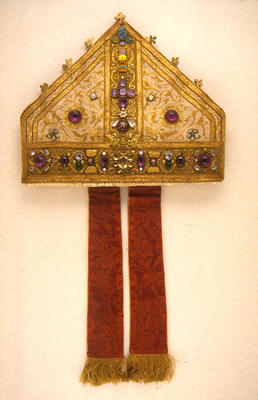
Rumor has it that Austin's new bishop has been chosen by the Holy Father !
But it would be imprudent to mention a name.
Soon (hopefully tomorrow !) we should have some news. Stay tuned !
Sunday, October 4, 2009
The New Media
The admirable Fr. Finigan of THE HERMENEUTIC OF CONTINUITY has noted and translated the report of the communiqué of the Pontifical Council for Social Communications. The title link above takes one to it, but I reproduce the text below.
Encouragement for Catholic bloggers
The other day, as is customary on the feast of the Holy Archangels, the Holy See announced the theme of next year's World Communications Day:
The priest and pastoral ministry in a digital world: new media at the service of the Word.
A report of the communiqué of the Pontifical Council for Social Communications has appeared on Zenit but I could not find a translation of the full text of the communiqué. So, in the spirit of the communiqué itself, here is my own translation:
The principal task of the priest is to announce the Word of God made flesh, man, history, becoming in this way a sign of that communion which God effects with man. The efficacy of this ministry requires therefore that the priest should live an intimate relationship with God, rooted in a profound love and in a living awareness of the Sacred Scriptures, "witness" in written form of the divine Word.
The message for the 44th World Day of Social Communications seeks to invite priests in a particular way, during this Year of the Priest, and after the celebration of the 12th Ordinary General Assembly of the Synod of Bishops, to consider the new media as possibly a major resource for their ministry at the service of the Word and seeks to offer a word of encouragement so that they might confront the challenges which arise from the new digital culture.
The new media in fact, if adequately known and valued, can offer to priests and to all pastoral workers a richness of data and content which was previously difficult to access, and facilitates forms of collaboration and of growth of communion unthinkable in the past. Thanks to the new media, the one who preaches and makes known the Word of life, can reach with words, sounds and images - the true and specific expressive grammar of the digital culture - individual people and entire cultures in every continent, to create new opportunities for awareness and dialogue, linked with the proposal and realisation of journeys of communion.
If used wisely, with the help of experts in the technology and culture of communications, the new media can thus become for priests and for all pastoral workers a valuable and effective instrument of true and profound evangelisation and communion. They will be a new form of evangelisation so that Christ should help the lives of our cities to to progress, and at the threshold of our houses should say anew "Behold, I stand at the door and knock. If anyone hears my voice and opens the door, I will come in to him, I will sup with him and he with me." (Rev 3.20)
As ever, the Holy See encourages us to use the new media with prudence and responsibility. Any of us may fail in these virtues from time to time but that is no excuse for people simply to dismiss all the "terrible blogs". There are many good priests and lay people out there working hard to use the new media in the service of the gospel. The Holy See has given a very positive signal and it deserves to be respected.
----------------------------------------------------------------------------------
Looks like the Holy See expects Catholic blogging to be around awhile, huh ?
Encouragement for Catholic bloggers
The other day, as is customary on the feast of the Holy Archangels, the Holy See announced the theme of next year's World Communications Day:
The priest and pastoral ministry in a digital world: new media at the service of the Word.
A report of the communiqué of the Pontifical Council for Social Communications has appeared on Zenit but I could not find a translation of the full text of the communiqué. So, in the spirit of the communiqué itself, here is my own translation:
The principal task of the priest is to announce the Word of God made flesh, man, history, becoming in this way a sign of that communion which God effects with man. The efficacy of this ministry requires therefore that the priest should live an intimate relationship with God, rooted in a profound love and in a living awareness of the Sacred Scriptures, "witness" in written form of the divine Word.
The message for the 44th World Day of Social Communications seeks to invite priests in a particular way, during this Year of the Priest, and after the celebration of the 12th Ordinary General Assembly of the Synod of Bishops, to consider the new media as possibly a major resource for their ministry at the service of the Word and seeks to offer a word of encouragement so that they might confront the challenges which arise from the new digital culture.
The new media in fact, if adequately known and valued, can offer to priests and to all pastoral workers a richness of data and content which was previously difficult to access, and facilitates forms of collaboration and of growth of communion unthinkable in the past. Thanks to the new media, the one who preaches and makes known the Word of life, can reach with words, sounds and images - the true and specific expressive grammar of the digital culture - individual people and entire cultures in every continent, to create new opportunities for awareness and dialogue, linked with the proposal and realisation of journeys of communion.
If used wisely, with the help of experts in the technology and culture of communications, the new media can thus become for priests and for all pastoral workers a valuable and effective instrument of true and profound evangelisation and communion. They will be a new form of evangelisation so that Christ should help the lives of our cities to to progress, and at the threshold of our houses should say anew "Behold, I stand at the door and knock. If anyone hears my voice and opens the door, I will come in to him, I will sup with him and he with me." (Rev 3.20)
As ever, the Holy See encourages us to use the new media with prudence and responsibility. Any of us may fail in these virtues from time to time but that is no excuse for people simply to dismiss all the "terrible blogs". There are many good priests and lay people out there working hard to use the new media in the service of the gospel. The Holy See has given a very positive signal and it deserves to be respected.
----------------------------------------------------------------------------------
Looks like the Holy See expects Catholic blogging to be around awhile, huh ?
Thursday, October 1, 2009
The end...
...of Planned Parenthood ?!
If this movie is legit and actually hits the theaters, who knows what might happen ?
Blessed Teresa of Calcutta, patroness of the unborn : pray for us !
If this movie is legit and actually hits the theaters, who knows what might happen ?
Blessed Teresa of Calcutta, patroness of the unborn : pray for us !
Friday, September 25, 2009

This is a shot of our processional crucifix and the High Altar in out beautiful chapel.
(Thanks to Darrell Miller.)
I am at this moment right in the midst of a one day silent retreat here at St. Mary's.
We have a little "alone" time before we end with Vespers, Adoration, and Benediction, and I thought it would be a good chance to finally write a few thoughts about being in seminary.
I'm not quite sure what I expected before I got here, because I consciously avoided trying to imagine what it is like. I'm very glad that I came with few preconceived notions.
The main thing I am most aware of a great deal of the time is the miracle of my being here at all. When I look back over the wreckage of my past, especially the years in New Orleans, I am in awe of God's Providence. I ran from Him as hard as I could possibly run for about 22 years, and He didn't abandon me; in fact, despite all the pain, danger, and sin, He protected me. I should be dead; instead, I'm in priestly formation. I may never fully get my head around that. His mercy does indeed endure forever.
Although my life has radically changed over the last 90 days--first moving into Borromeo House on the 1st. of July, then getting here on the Feast of the Assumption-- I feel like I have adjusted pretty well. It has been a monumental change, but it doesn't really feel like it. I guess all the stuff I've been through over the years has made me more flexible and adaptable than I thought I was.
Thats not to say it has been easy. Our time is very full here, and I struggle with time management (never one of my strengths); I also struggle with smoking, eating too much, and a number of other besetting sins. But I am managing with God's help, and I fully expect that He will continue to give me the grace to improve, as I am open to receive it. In a way this is going to be a long 7 years...yet I pray that one day I will look back on these entries as a priest and wonder where in the world all that time went.
When I was discerning my vocation I had a lot of "wants". I wanted to go to a diocese closer to my family; I wanted to go to a more tradition-oriented seminary. But the longer I am here the more I am beginning to realize that God has me right where He wants me. As far as He is concerned, this is the perfect place...and that is all that matters.
My brother seminarians amaze me. To the last man, they are all devout and serious lovers of Jesus. Not all of us will likely make it to priesthood; statistically and for various reasons some of us will leave. But I have yet to meet even one that I don't think is called to be here. Each of them is an encouragement and an inspiration, and I have begun to develop friendships that I hope will be lifelong.
Our priestly staff is top notch. I am learning so much from them about what priesthood and walking with Christ means-- the joys, the struggles, the riches and the sorrows. Some of them have been ordained over 50 years ! What a treasure trove of wisdom to draw on.
The academic staff is great too. Yes, I have a couple of professors who grate on my orthodoxy. Sometimes I experience the "gnashing of teeth." But I have been put in front of them for a reason; they have something to teach that I need to learn. I am trying to be open-minded and just listen. Even when its "bad", it isn't really bad. This is perhaps God's way of telling me not to be such a Pharisee.
The common prayer we share here is incredible. Morning and Evening Prayer, daily Mass, the rosary, Exposition and Benediction...it is so fulfilling to be immersed into this constant rhythm of prayer with the whole Church. What a blessing. I have hungered for this for a very long time.
Well, my time's up : 5 pm is Vespers. Just a little taste of St. Mary's, which I hope to expand upon regularly. I truly want this to be a spiritual journal of my experience here. With God leading the way, its going to be quite an adventure.
Anyone reading this (besides the faithful Mickie !), please pray for me !
Tuesday, September 1, 2009
Awesome video
Well, I've been here at St. Mary's in Houston now for 2 1/2 weeks, and haven't posted yet. I sincerely hope to get something substantive up soon; in the meantime, this video says just about everything, anyway.
Monday, August 10, 2009
A real conservative vision
(Click on title link above)
Economic quagmire seen due to moral decline
By Jeffrey Kuhner | Saturday, August 1, 2009
Conservatives are searching for a leader. Move over Rush Limbaugh, Sarah Palin and Mitt Romney. Pope Benedict XVI has emerged as the great conservative champion.
In his recently issued and much anticipated third encyclical, "Caritas in Veritate" ("Love in Truth"), the pope lays out a brilliant blueprint for addressing the seminal problems of our age.
Contrary to headlines, the encyclical is not an anti-capitalist tract. The pope is not a red Tory who puts "social justice" and statist economics above free markets. He does not call for big-government liberalism. Instead, he upholds free markets while also addressing the moral and theological roots of culture.
The pope rightly argues that the current economic crisis was caused by rampant greed, irresponsible financial speculation and the failure of government regulation. In other words, it has occurred within a moral vacuum, where Christian love and truth have been abandoned in favor of crude materialism.
The crisis has become "an opportunity for discernment, in which to shape a new vision for the future." The economic debacle is simply a symptom of a deeper and more dangerous moral crisis. The only solution, he says, is to restore Christendom -- what used to be the essence of Western civilization.
He puts forth a vision conservatives should embrace. The pope is articulating a conservative humanism characterized by individual freedom, responsible capitalism, the importance of national sovereignty and distinct cultural identity, voluntary trade unionism, decentralization of political power and moral traditionalism.
The pope does not blame capitalism for the world's current economic problems. On the contrary, he states unequivocally, "Society does not have to protect itself from the market, as if the development of the latter were ipso facto to entail the death of authentically human relations." Instead, he stresses that a market economy is shaped and driven by cultural underpinnings. If the culture is rotten, gangster capitalism inevitably flourishes. If it is morally healthy, a socially responsible free market takes root.
The pope is pro-globalization, pro-trade and pro-scientific innovation -- even demanding that wealthier countries lower protectionist trade barriers to products from poorer nations. This will lower consumer prices and help boost exports for developing economies.
Yet the pope believes in a redistributive capitalism in which wealth is distributed more equally to the poor and disadvantaged. The state has some role to play -- unemployment insurance and local charity, for example. But much of the redistribution should be voluntary and part of a mutually beneficial exchange. In other words, he is calling us to follow Christ's injunction to take care of the weakest among us.
The pope rightly argues that the "values of Christianity" are "not merely useful but essential for building a good society and for true integral human development." The West, however, is embarked upon a radical secular experiment. We are rejecting our Judeo-Christian heritage. We are suffering from profound spiritual malaise fostered by the loss of moral absolutes. The result is hedonism, consumerism sexual permissiveness and individual gratification. As in ancient Rome, this leads to gradual social disintegration.
Although the pope never explicitly says it, the West is dying - literally. Fertility rates in every European country are below replacement levels. A total fertility rate of 2.1 babies per woman is needed if the population is to sustain itself. In the European Union as a whole, the birthrate is just 1.5. In Germany and Austria, it is 1.4. In Italy, Spain and Greece, it is a meager 1.3. The only nation that is close to replacement levels is France at 2.0 -- and that is mainly because of the soaring birthrates of its large Muslim community.
In America, the fertility rate is slightly above 2.1, but much of that is because of Hispanics and their offspring, who still have numerous children. Cradle-to-grave welfare states require young workers to support the costly pension and health care programs for aging citizens. Hence, every Western country has embarked upon a policy of massive Third World immigration. The result is multiculturalism and a direct assault on the West's historic and cultural core. Demography is destiny - and the future is not with the West.
The pope thinks the key to the West's revival is to return to the faith of its ancestors: the Roman Catholic Church. He states clearly that any good society begins by defending the right to life from conception until natural death. The traditional family based on the marriage of one man and one woman is the seminal institution of any viable social order.
Pope Benedict's conservatism is a bulwark against the evils of modern liberalism. The left's main project has been to construct a society without God; to create a new man -- one who is the center of all things. In the 20th century, leftists embraced communism and fascism. They failed. Today, it is socialist multiculturalism and radical environmentalism. They will fail as well.
In essence, the pope believes the economic crisis is a result of a moral crisis: Its ultimate solution will therefore not be found in tinkering with the material -- as in simple policy reforms -- but in renewing our spiritual underpinnings.
The pope understands this eternal truth: Societies cannot endure for long without a belief in God and a submission to His will. We are ignoring him at our peril.
Jeffrey T. Kuhner is a columnist at The Washington Times and president of the Edmund Burke Institute, a Washington-based think tank.
Copyright 2009 The Washington Times, LLC
Economic quagmire seen due to moral decline
By Jeffrey Kuhner | Saturday, August 1, 2009
Conservatives are searching for a leader. Move over Rush Limbaugh, Sarah Palin and Mitt Romney. Pope Benedict XVI has emerged as the great conservative champion.
In his recently issued and much anticipated third encyclical, "Caritas in Veritate" ("Love in Truth"), the pope lays out a brilliant blueprint for addressing the seminal problems of our age.
Contrary to headlines, the encyclical is not an anti-capitalist tract. The pope is not a red Tory who puts "social justice" and statist economics above free markets. He does not call for big-government liberalism. Instead, he upholds free markets while also addressing the moral and theological roots of culture.
The pope rightly argues that the current economic crisis was caused by rampant greed, irresponsible financial speculation and the failure of government regulation. In other words, it has occurred within a moral vacuum, where Christian love and truth have been abandoned in favor of crude materialism.
The crisis has become "an opportunity for discernment, in which to shape a new vision for the future." The economic debacle is simply a symptom of a deeper and more dangerous moral crisis. The only solution, he says, is to restore Christendom -- what used to be the essence of Western civilization.
He puts forth a vision conservatives should embrace. The pope is articulating a conservative humanism characterized by individual freedom, responsible capitalism, the importance of national sovereignty and distinct cultural identity, voluntary trade unionism, decentralization of political power and moral traditionalism.
The pope does not blame capitalism for the world's current economic problems. On the contrary, he states unequivocally, "Society does not have to protect itself from the market, as if the development of the latter were ipso facto to entail the death of authentically human relations." Instead, he stresses that a market economy is shaped and driven by cultural underpinnings. If the culture is rotten, gangster capitalism inevitably flourishes. If it is morally healthy, a socially responsible free market takes root.
The pope is pro-globalization, pro-trade and pro-scientific innovation -- even demanding that wealthier countries lower protectionist trade barriers to products from poorer nations. This will lower consumer prices and help boost exports for developing economies.
Yet the pope believes in a redistributive capitalism in which wealth is distributed more equally to the poor and disadvantaged. The state has some role to play -- unemployment insurance and local charity, for example. But much of the redistribution should be voluntary and part of a mutually beneficial exchange. In other words, he is calling us to follow Christ's injunction to take care of the weakest among us.
The pope rightly argues that the "values of Christianity" are "not merely useful but essential for building a good society and for true integral human development." The West, however, is embarked upon a radical secular experiment. We are rejecting our Judeo-Christian heritage. We are suffering from profound spiritual malaise fostered by the loss of moral absolutes. The result is hedonism, consumerism sexual permissiveness and individual gratification. As in ancient Rome, this leads to gradual social disintegration.
Although the pope never explicitly says it, the West is dying - literally. Fertility rates in every European country are below replacement levels. A total fertility rate of 2.1 babies per woman is needed if the population is to sustain itself. In the European Union as a whole, the birthrate is just 1.5. In Germany and Austria, it is 1.4. In Italy, Spain and Greece, it is a meager 1.3. The only nation that is close to replacement levels is France at 2.0 -- and that is mainly because of the soaring birthrates of its large Muslim community.
In America, the fertility rate is slightly above 2.1, but much of that is because of Hispanics and their offspring, who still have numerous children. Cradle-to-grave welfare states require young workers to support the costly pension and health care programs for aging citizens. Hence, every Western country has embarked upon a policy of massive Third World immigration. The result is multiculturalism and a direct assault on the West's historic and cultural core. Demography is destiny - and the future is not with the West.
The pope thinks the key to the West's revival is to return to the faith of its ancestors: the Roman Catholic Church. He states clearly that any good society begins by defending the right to life from conception until natural death. The traditional family based on the marriage of one man and one woman is the seminal institution of any viable social order.
Pope Benedict's conservatism is a bulwark against the evils of modern liberalism. The left's main project has been to construct a society without God; to create a new man -- one who is the center of all things. In the 20th century, leftists embraced communism and fascism. They failed. Today, it is socialist multiculturalism and radical environmentalism. They will fail as well.
In essence, the pope believes the economic crisis is a result of a moral crisis: Its ultimate solution will therefore not be found in tinkering with the material -- as in simple policy reforms -- but in renewing our spiritual underpinnings.
The pope understands this eternal truth: Societies cannot endure for long without a belief in God and a submission to His will. We are ignoring him at our peril.
Jeffrey T. Kuhner is a columnist at The Washington Times and president of the Edmund Burke Institute, a Washington-based think tank.
Copyright 2009 The Washington Times, LLC
Tuesday, August 4, 2009
Le Curé d’Ars + 1859

Memoria sancti Ioannis Mariae Vianney, presbyteri, qui, quadraginta amplius annos paroeciae ipsi commissae in vico Ars prope Bellicium in Gallia actuosa praedicatione, oratione et paenitentiae exemplo mirum in modum ministravit et cotidie pueros et adultos catechizans, paenitentes reconcilians atque ardenti caritate e sacra Eucharistia velut e fonte hausta refulgens tantopere provexit, ut longe lateque consilia sua diffunderet et permultos ad Deum sapienter duceret.
(2005 Martyrologium Romanum)
"My little children, your hearts are small, but prayer stretches them and makes them capable of loving God."
(Thanks to Fr. Z for that quote.)
On the feast day of this great but unlikely saint, I ask for his prayers as I make hurried and frantic preparations to enter St. Mary's Seminary in a little over a week's time.
Here's a really good article from Zenit I just found :
(http://www.zenit.org/article-26225?l=english)
Curé d'Ars: Model Priest
Confessor Knew the Importance of the Basics
By Karna Swanson
NEW YORK, JUNE 19, 2009 (Zenit.org).- After more than 2,000 years of existence, there isn't much the Church hasn't addressed, faced or witnessed.
Granted, times change. New challenges continually present themselves. Progress is made. And while the Church continually works to keep step with the twists and turns of history, it sometimes breaks step and simply returns to the basics.
This is what Benedict XVI did recently when he declared a yearlong celebration of one of the most basic and fundamental elements of the Catholic Church: the priesthood.
Beginning today, the Church will dedicate one full year to remembering what it is to be a priest. This will not only be an opportunity for priests to rediscover their vocation, mission and passion for Christ, but it's also a chance for the rest of us to rediscover what a gift the priesthood is for our own lives.
The Pontiff chose as the occasion for this jubilee year the 150th anniversary of the death of St. John Mary Vianney, known as the Curé d'Ars.
By linking the Year for Priests with St. Vianney, who is also the patron of parish priests, the jubilee not only celebrates the basics of the Church, but also the basics of the priesthood itself.
As a priest, Father Vianney took upon himself many of the projects parish priests take on. He set about to restore the parish church, he founded an orphanage and did acts of charity for the poor. He also did some pretty extraordinary things. He had supernatural knowledge of the future and the past, and he performed healing miracles, particularly on children.
But it was in the basic duties of parish life that he excelled, namely preaching, offering spiritual direction, and, most notably, hearing confessions.
Rocky road
John Mary Vianney was born in Dardilly, near Leon, in 1786. His early faith formation took place within the context of the French Revolution, which pushed the practice of the Catholic faith underground. Later in his ministry, he would deal with the consequences of the revolution, which led many of the faithful to leave the Church.
The road to the priesthood wasn't an easy path for Vianney. After finally getting his father's permission to pursue his calling, he still needed to get caught up on his studies, as the revolution had interrupted his education. If he wanted to be a priest, he'd have to go back to school with children half his age to learn the basics of reading, writing, and Latin.
Almost nine years later, in 1815, Vianney was ordained. He was 29. Less than three years later, in 1818, the young priest was assigned as the assistant pastor of the church in Ars, a small country village located about 25 miles from Lyon in eastern France. This is where he would spend the rest of his priestly life.
Arriving in Ars, the young priest noticed the loss of Christian faith and morals around him, a lingering by-product of the French Revolution. Father Vianney soon began to awaken the faith of his parishioners through his preaching, but most of all by his prayer and his way of life. His notoriety as a holy priest grew slowly, and Father Vianney soon became known as, simply, the Curé d'Ars (priest of Ars).
Not paparazzi, penitents
By the 1830s, his popularity swelled to the extent that the holy priest became somewhat of a prisoner in the confessional, held there by the hundreds of faithful arriving daily to the village to see the holy curé. Between 1830 and 1845, sometimes as many as 300 people a day would pass through Ars for a chance to confess with Father Vianney.
Overwhelmed with his own sense of unworthiness and weakness in the face of such a great mission, the holy priest tried three times to escape, but all attempts failed. On the third attempt his parishioners actually sent out a search crew in the middle of the night to find him and put him back in the confessional. He stayed there until the wee hours of the morning -- hearing confessions.
In 1853, a group of diocesan missionaries came to the aid of the overworked parish priest, who couldn't seem to get out of his confessional, let alone out of his own parish to take a holiday. His own bishop even told him not to attend diocesan retreats, as Father Vianney had too many souls to attend to in Ars.
By 1855, the number of pilgrims had reached 20,000 a year, and some 100,000 in 1858. There are reports that during the last 10 years of his life, he spent as many as 18 hours a day in the confessional, and that toward the end of his life, he confessed up to 80,000 penitents a year.
Father Vianney spent the last five days of his life hearing his confessions from his deathbed. Exhausted, the Curé d'Ars died Aug. 4, 1859. He was 73.
The parish priest was beatified in 1905, and declared the patron of the priests of France that same year. He was canonized 20 years later in 1925, and declared the patron saint of all parish priests in 1929.
A hero
In 1959, Pope John XXIII wrote a 13,000-word encyclical on St. John Mary Vianney on the centenary of the saint's death. He hailed the holy priest an "outstanding model of priestly asceticism, of piety, especially in the form of devotion to the Eucharist, and, finally, of pastoral zeal."
He was a "tireless worker for God," the Holy Father continued, and "a hero."
"His only motives were the love of God and the desire for the salvation of the souls of his neighbors," the Pontiff affirmed.
John XIII offered St. Vianney as a model for other priests because the saint was a man of God. This, he said, was the secret to the priesthood: "A man who is filled with Christ will not find it hard to discover ways and means of bringing others to Christ."
The Curé d'Ars is also a model for priests because he, like few others, knew what being a priest was all about.
"Holy Orders," he wrote in his Catechism on the Priesthood, "is a sacrament which seems to relate to no one among you, and which yet relates to everyone."
A priest, he continued, is "a man who holds the place of God -- a man who is invested with all the powers of God."
"Everything has come to us through the priest; yes, all happiness, all graces, all heavenly gifts," St. Vianney affirmed. "If we had not the sacrament of orders, we should not have Our Lord.
"Who placed him there, in that tabernacle? It was the priest. Who was it that received your soul, on its entrance into life? The priest. Who nourishes it, to give it strength to make its pilgrimage? The priest. Who will prepare it to appear before God, by washing that soul, for the last time, in the blood of Jesus Christ? The priest -- always the priest."
St. Vianney spoke of the priest as the doorway to the treasures of heaven, "He is the steward of the good God, the distributor of his wealth."
"Oh, how great is a priest," he exclaimed. So great, he noted, that it would be impossible for a priest to "understand the greatness of his office till he is in heaven. If he understood it on earth, he would die, not of fear, but of love."
And a priest, he continued, "is not a priest for himself."
It's often overlooked that a priest does not confess himself or administer the sacraments for himself. All of his priestly duties and functions are done for others. "He is not for himself," the holy Curé reminds us. "He is for you."
When you see a priest, you should say, "There is he who made me a child of God, and opened heaven to me by holy baptism; he who purified me after I had sinned; who gives nourishment to my soul."
"The priesthood is the love of the heart of Jesus," he added. "When you see the priest, think of Our Lord Jesus Christ."
This year, we have the opportunity to just do that.
[Karna Swanson is the editor of ZENIT's English edition.]
*************************************************************
St. John Vianney, ora pro nobis !
Sacred Heart of Jesus, make me a priest like him !
Wednesday, July 8, 2009
Caritas in Veritate

ENCYCLICAL LETTER
CARITAS IN VERITATE
OF THE SUPREME PONTIFF
BENEDICT XVI
TO THE BISHOPS,PRIESTS AND DEACONS
MEN AND WOMEN RELIGIOUS
THE LAY FAITHFUL
AND ALL PEOPLE OF GOOD WILL
ON INTEGRAL HUMAN DEVELOPMENT
IN CHARITY AND TRUTH
-------------------------------------------------------------------------------------
As a guy I knew in the Army used to say,
"Read it. Learn it. Live it."
Considering all the criticism it garnered even before it hit the presses, it has GOT to be good.
Good post
I found this very informative post (click on title above) on Whispers in the Loggia about Archbishop Aymond's elevation to the See of New Orleans. It is not a new post, but sums up the situation nicely.
I will be meeting one-on-one with the Archbishop for the first and probably last time in about a week. I am a bit nervous, though I don't have any real reason to be. His Excellency is very easy to talk to.
I was actually looking for any news/ hints about who our new bishop might be, to no avail. I am understandably curious about the identity of my new boss !
My Vocation Director, Fr. Mike Sis (an awesome priest whom I admire very much, and who is also switching jobs soon) just returned from Italy last night with interesting stories about the Pallium Mass...sigh. God, speed the day when I can get to Rome !!
I will be meeting one-on-one with the Archbishop for the first and probably last time in about a week. I am a bit nervous, though I don't have any real reason to be. His Excellency is very easy to talk to.
I was actually looking for any news/ hints about who our new bishop might be, to no avail. I am understandably curious about the identity of my new boss !
My Vocation Director, Fr. Mike Sis (an awesome priest whom I admire very much, and who is also switching jobs soon) just returned from Italy last night with interesting stories about the Pallium Mass...sigh. God, speed the day when I can get to Rome !!
Friday, July 3, 2009
Happy Independence Day !!!
(About two hours early...tomorrow I'll be watching fireworks !)
 One of the greatest and most noble documents in the history of the world.
I am often absolutely astounded when I consider what the odds were against there being such a collection of brilliant patriots in one place at one time as there was at the Continental Congress in July of 1776.
Thank you, gracious God, for our history, our nation, and our faith.
St. Mary of the Immaculate Conception, Patroness of The United States of America, keep us under your mantle of love and never cease to pray for us.
Here is one of my favorite scenes from one of my favorite movies : 1776
Somehow I think this is very much like it was that hot day in Philadelphia.
IN CONGRESS, July 4, 1776.
The unanimous Declaration of the thirteen united States of America,
When in the Course of human events, it becomes necessary for one people to dissolve the political bands which have connected them with another, and to assume among the powers of the earth, the separate and equal station to which the Laws of Nature and of Nature's God entitle them, a decent respect to the opinions of mankind requires that they should declare the causes which impel them to the separation.
We hold these truths to be self-evident, that all men are created equal, that they are endowed by their Creator with certain unalienable Rights, that among these are Life, Liberty and the pursuit of Happiness.--That to secure these rights, Governments are instituted among Men, deriving their just powers from the consent of the governed, --That whenever any Form of Government becomes destructive of these ends, it is the Right of the People to alter or to abolish it, and to institute new Government, laying its foundation on such principles and organizing its powers in such form, as to them shall seem most likely to effect their Safety and Happiness. Prudence, indeed, will dictate that Governments long established should not be changed for light and transient causes; and accordingly all experience hath shewn, that mankind are more disposed to suffer, while evils are sufferable, than to right themselves by abolishing the forms to which they are accustomed. But when a long train of abuses and usurpations, pursuing invariably the same Object evinces a design to reduce them under absolute Despotism, it is their right, it is their duty, to throw off such Government, and to provide new Guards for their future security.--Such has been the patient sufferance of these Colonies; and such is now the necessity which constrains them to alter their former Systems of Government. The history of the present King of Great Britain is a history of repeated injuries and usurpations, all having in direct object the establishment of an absolute Tyranny over these States. To prove this, let Facts be submitted to a candid world.
He has refused his Assent to Laws, the most wholesome and necessary for the public good.
He has forbidden his Governors to pass Laws of immediate and pressing importance, unless suspended in their operation till his Assent should be obtained; and when so suspended, he has utterly neglected to attend to them.
He has refused to pass other Laws for the accommodation of large districts of people, unless those people would relinquish the right of Representation in the Legislature, a right inestimable to them and formidable to tyrants only.
He has called together legislative bodies at places unusual, uncomfortable, and distant from the depository of their public Records, for the sole purpose of fatiguing them into compliance with his measures.
He has dissolved Representative Houses repeatedly, for opposing with manly firmness his invasions on the rights of the people.
He has refused for a long time, after such dissolutions, to cause others to be elected; whereby the Legislative powers, incapable of Annihilation, have returned to the People at large for their exercise; the State remaining in the mean time exposed to all the dangers of invasion from without, and convulsions within.
He has endeavoured to prevent the population of these States; for that purpose obstructing the Laws for Naturalization of Foreigners; refusing to pass others to encourage their migrations hither, and raising the conditions of new Appropriations of Lands.
He has obstructed the Administration of Justice, by refusing his Assent to Laws for establishing Judiciary powers.
He has made Judges dependent on his Will alone, for the tenure of their offices, and the amount and payment of their salaries.
He has erected a multitude of New Offices, and sent hither swarms of Officers to harrass our people, and eat out their substance.
He has kept among us, in times of peace, Standing Armies without the Consent of our legislatures.
He has affected to render the Military independent of and superior to the Civil power.
He has combined with others to subject us to a jurisdiction foreign to our constitution, and unacknowledged by our laws; giving his Assent to their Acts of pretended Legislation:
For Quartering large bodies of armed troops among us:
For protecting them, by a mock Trial, from punishment for any Murders which they should commit on the Inhabitants of these States:
For cutting off our Trade with all parts of the world:
For imposing Taxes on us without our Consent:
For depriving us in many cases, of the benefits of Trial by Jury:
For transporting us beyond Seas to be tried for pretended offences
For abolishing the free System of English Laws in a neighbouring Province, establishing therein an Arbitrary government, and enlarging its Boundaries so as to render it at once an example and fit instrument for introducing the same absolute rule into these Colonies:
For taking away our Charters, abolishing our most valuable Laws, and altering fundamentally the Forms of our Governments:
For suspending our own Legislatures, and declaring themselves invested with power to legislate for us in all cases whatsoever.
He has abdicated Government here, by declaring us out of his Protection and waging War against us.
He has plundered our seas, ravaged our Coasts, burnt our towns, and destroyed the lives of our people.
He is at this time transporting large Armies of foreign Mercenaries to compleat the works of death, desolation and tyranny, already begun with circumstances of Cruelty & perfidy scarcely paralleled in the most barbarous ages, and totally unworthy the Head of a civilized nation.
He has constrained our fellow Citizens taken Captive on the high Seas to bear Arms against their Country, to become the executioners of their friends and Brethren, or to fall themselves by their Hands.
He has excited domestic insurrections amongst us, and has endeavoured to bring on the inhabitants of our frontiers, the merciless Indian Savages, whose known rule of warfare, is an undistinguished destruction of all ages, sexes and conditions.
In every stage of these Oppressions We have Petitioned for Redress in the most humble terms: Our repeated Petitions have been answered only by repeated injury. A Prince whose character is thus marked by every act which may define a Tyrant, is unfit to be the ruler of a free people.
Nor have We been wanting in attentions to our Brittish brethren. We have warned them from time to time of attempts by their legislature to extend an unwarrantable jurisdiction over us. We have reminded them of the circumstances of our emigration and settlement here. We have appealed to their native justice and magnanimity, and we have conjured them by the ties of our common kindred to disavow these usurpations, which, would inevitably interrupt our connections and correspondence. They too have been deaf to the voice of justice and of consanguinity. We must, therefore, acquiesce in the necessity, which denounces our Separation, and hold them, as we hold the rest of mankind, Enemies in War, in Peace Friends.
We, therefore, the Representatives of the united States of America, in General Congress, Assembled, appealing to the Supreme Judge of the world for the rectitude of our intentions, do, in the Name, and by Authority of the good People of these Colonies, solemnly publish and declare, That these United Colonies are, and of Right ought to be Free and Independent States; that they are Absolved from all Allegiance to the British Crown, and that all political connection between them and the State of Great Britain, is and ought to be totally dissolved; and that as Free and Independent States, they have full Power to levy War, conclude Peace, contract Alliances, establish Commerce, and to do all other Acts and Things which Independent States may of right do. And for the support of this Declaration, with a firm reliance on the protection of divine Providence, we mutually pledge to each other our Lives, our Fortunes and our sacred Honor.--------------------------------------------------------------------------------
The 56 signatures on the Declaration appear in the positions indicated:
Column 1
Georgia:
Button Gwinnett
Lyman Hall
George Walton
Column 2
North Carolina:
William Hooper
Joseph Hewes
John Penn
South Carolina:
Edward Rutledge
Thomas Heyward, Jr.
Thomas Lynch, Jr.
Arthur Middleton
Column 3
Massachusetts:
John Hancock
Maryland:
Samuel Chase
William Paca
Thomas Stone
Charles Carroll of Carrollton
Virginia:
George Wythe
Richard Henry Lee
Thomas Jefferson
Benjamin Harrison
Thomas Nelson, Jr.
Francis Lightfoot Lee
Carter Braxton
Column 4
Pennsylvania:
Robert Morris
Benjamin Rush
Benjamin Franklin
John Morton
George Clymer
James Smith
George Taylor
James Wilson
George Ross
Delaware:
Caesar Rodney
George Read
Thomas McKean
Column 5
New York:
William Floyd
Philip Livingston
Francis Lewis
Lewis Morris
New Jersey:
Richard Stockton
John Witherspoon
Francis Hopkinson
John Hart
Abraham Clark
Column 6
New Hampshire:
Josiah Bartlett
William Whipple
Massachusetts:
Samuel Adams
John Adams
Robert Treat Paine
Elbridge Gerry
Rhode Island:
Stephen Hopkins
William Ellery
Connecticut:
Roger Sherman
Samuel Huntington
William Williams
Oliver Wolcott
New Hampshire:
Matthew Thornton
 One of the greatest and most noble documents in the history of the world.
I am often absolutely astounded when I consider what the odds were against there being such a collection of brilliant patriots in one place at one time as there was at the Continental Congress in July of 1776.
Thank you, gracious God, for our history, our nation, and our faith.
St. Mary of the Immaculate Conception, Patroness of The United States of America, keep us under your mantle of love and never cease to pray for us.
Here is one of my favorite scenes from one of my favorite movies : 1776
Somehow I think this is very much like it was that hot day in Philadelphia.
IN CONGRESS, July 4, 1776.
The unanimous Declaration of the thirteen united States of America,
When in the Course of human events, it becomes necessary for one people to dissolve the political bands which have connected them with another, and to assume among the powers of the earth, the separate and equal station to which the Laws of Nature and of Nature's God entitle them, a decent respect to the opinions of mankind requires that they should declare the causes which impel them to the separation.
We hold these truths to be self-evident, that all men are created equal, that they are endowed by their Creator with certain unalienable Rights, that among these are Life, Liberty and the pursuit of Happiness.--That to secure these rights, Governments are instituted among Men, deriving their just powers from the consent of the governed, --That whenever any Form of Government becomes destructive of these ends, it is the Right of the People to alter or to abolish it, and to institute new Government, laying its foundation on such principles and organizing its powers in such form, as to them shall seem most likely to effect their Safety and Happiness. Prudence, indeed, will dictate that Governments long established should not be changed for light and transient causes; and accordingly all experience hath shewn, that mankind are more disposed to suffer, while evils are sufferable, than to right themselves by abolishing the forms to which they are accustomed. But when a long train of abuses and usurpations, pursuing invariably the same Object evinces a design to reduce them under absolute Despotism, it is their right, it is their duty, to throw off such Government, and to provide new Guards for their future security.--Such has been the patient sufferance of these Colonies; and such is now the necessity which constrains them to alter their former Systems of Government. The history of the present King of Great Britain is a history of repeated injuries and usurpations, all having in direct object the establishment of an absolute Tyranny over these States. To prove this, let Facts be submitted to a candid world.
He has refused his Assent to Laws, the most wholesome and necessary for the public good.
He has forbidden his Governors to pass Laws of immediate and pressing importance, unless suspended in their operation till his Assent should be obtained; and when so suspended, he has utterly neglected to attend to them.
He has refused to pass other Laws for the accommodation of large districts of people, unless those people would relinquish the right of Representation in the Legislature, a right inestimable to them and formidable to tyrants only.
He has called together legislative bodies at places unusual, uncomfortable, and distant from the depository of their public Records, for the sole purpose of fatiguing them into compliance with his measures.
He has dissolved Representative Houses repeatedly, for opposing with manly firmness his invasions on the rights of the people.
He has refused for a long time, after such dissolutions, to cause others to be elected; whereby the Legislative powers, incapable of Annihilation, have returned to the People at large for their exercise; the State remaining in the mean time exposed to all the dangers of invasion from without, and convulsions within.
He has endeavoured to prevent the population of these States; for that purpose obstructing the Laws for Naturalization of Foreigners; refusing to pass others to encourage their migrations hither, and raising the conditions of new Appropriations of Lands.
He has obstructed the Administration of Justice, by refusing his Assent to Laws for establishing Judiciary powers.
He has made Judges dependent on his Will alone, for the tenure of their offices, and the amount and payment of their salaries.
He has erected a multitude of New Offices, and sent hither swarms of Officers to harrass our people, and eat out their substance.
He has kept among us, in times of peace, Standing Armies without the Consent of our legislatures.
He has affected to render the Military independent of and superior to the Civil power.
He has combined with others to subject us to a jurisdiction foreign to our constitution, and unacknowledged by our laws; giving his Assent to their Acts of pretended Legislation:
For Quartering large bodies of armed troops among us:
For protecting them, by a mock Trial, from punishment for any Murders which they should commit on the Inhabitants of these States:
For cutting off our Trade with all parts of the world:
For imposing Taxes on us without our Consent:
For depriving us in many cases, of the benefits of Trial by Jury:
For transporting us beyond Seas to be tried for pretended offences
For abolishing the free System of English Laws in a neighbouring Province, establishing therein an Arbitrary government, and enlarging its Boundaries so as to render it at once an example and fit instrument for introducing the same absolute rule into these Colonies:
For taking away our Charters, abolishing our most valuable Laws, and altering fundamentally the Forms of our Governments:
For suspending our own Legislatures, and declaring themselves invested with power to legislate for us in all cases whatsoever.
He has abdicated Government here, by declaring us out of his Protection and waging War against us.
He has plundered our seas, ravaged our Coasts, burnt our towns, and destroyed the lives of our people.
He is at this time transporting large Armies of foreign Mercenaries to compleat the works of death, desolation and tyranny, already begun with circumstances of Cruelty & perfidy scarcely paralleled in the most barbarous ages, and totally unworthy the Head of a civilized nation.
He has constrained our fellow Citizens taken Captive on the high Seas to bear Arms against their Country, to become the executioners of their friends and Brethren, or to fall themselves by their Hands.
He has excited domestic insurrections amongst us, and has endeavoured to bring on the inhabitants of our frontiers, the merciless Indian Savages, whose known rule of warfare, is an undistinguished destruction of all ages, sexes and conditions.
In every stage of these Oppressions We have Petitioned for Redress in the most humble terms: Our repeated Petitions have been answered only by repeated injury. A Prince whose character is thus marked by every act which may define a Tyrant, is unfit to be the ruler of a free people.
Nor have We been wanting in attentions to our Brittish brethren. We have warned them from time to time of attempts by their legislature to extend an unwarrantable jurisdiction over us. We have reminded them of the circumstances of our emigration and settlement here. We have appealed to their native justice and magnanimity, and we have conjured them by the ties of our common kindred to disavow these usurpations, which, would inevitably interrupt our connections and correspondence. They too have been deaf to the voice of justice and of consanguinity. We must, therefore, acquiesce in the necessity, which denounces our Separation, and hold them, as we hold the rest of mankind, Enemies in War, in Peace Friends.
We, therefore, the Representatives of the united States of America, in General Congress, Assembled, appealing to the Supreme Judge of the world for the rectitude of our intentions, do, in the Name, and by Authority of the good People of these Colonies, solemnly publish and declare, That these United Colonies are, and of Right ought to be Free and Independent States; that they are Absolved from all Allegiance to the British Crown, and that all political connection between them and the State of Great Britain, is and ought to be totally dissolved; and that as Free and Independent States, they have full Power to levy War, conclude Peace, contract Alliances, establish Commerce, and to do all other Acts and Things which Independent States may of right do. And for the support of this Declaration, with a firm reliance on the protection of divine Providence, we mutually pledge to each other our Lives, our Fortunes and our sacred Honor.--------------------------------------------------------------------------------
The 56 signatures on the Declaration appear in the positions indicated:
Column 1
Georgia:
Button Gwinnett
Lyman Hall
George Walton
Column 2
North Carolina:
William Hooper
Joseph Hewes
John Penn
South Carolina:
Edward Rutledge
Thomas Heyward, Jr.
Thomas Lynch, Jr.
Arthur Middleton
Column 3
Massachusetts:
John Hancock
Maryland:
Samuel Chase
William Paca
Thomas Stone
Charles Carroll of Carrollton
Virginia:
George Wythe
Richard Henry Lee
Thomas Jefferson
Benjamin Harrison
Thomas Nelson, Jr.
Francis Lightfoot Lee
Carter Braxton
Column 4
Pennsylvania:
Robert Morris
Benjamin Rush
Benjamin Franklin
John Morton
George Clymer
James Smith
George Taylor
James Wilson
George Ross
Delaware:
Caesar Rodney
George Read
Thomas McKean
Column 5
New York:
William Floyd
Philip Livingston
Francis Lewis
Lewis Morris
New Jersey:
Richard Stockton
John Witherspoon
Francis Hopkinson
John Hart
Abraham Clark
Column 6
New Hampshire:
Josiah Bartlett
William Whipple
Massachusetts:
Samuel Adams
John Adams
Robert Treat Paine
Elbridge Gerry
Rhode Island:
Stephen Hopkins
William Ellery
Connecticut:
Roger Sherman
Samuel Huntington
William Williams
Oliver Wolcott
New Hampshire:
Matthew Thornton
Tuesday, June 30, 2009
The Pallium

Congratulations, Your Excellency !
Just hours ago, Archbishop Gregory Aymond, formerly of Austin and soon to be of New Orleans, was given the Pallium by His Holiness Pope Benedict XVI.
The man who confirmed me and admitted me to the program of priestly formation. A fine man and an honest and true shepherd. He will be sorely missed. (The title above is a link to the story)
 And somewhere in this crowd is Father Michael J. Sis, Vocations Director for the Diocese of Austin !
Saturday, June 27, 2009
Bishop Defends the Pope
This open letter from His Excellency Most Rev. Kurt Koch, Bishop of Basel, Switzerland, is terrific. (Borrowed from Fr. Z. You can read the good Father's excellent comments by following the title link above.) It expresses succinctly what so many of us in the Church feel about the way Vatican II has been implemented over the decades.
His Holiness is in the midst of talks with the Society of St. Pius X; ultimately it looks like these talks will result in some new teaching that is going to clarify the true meaning and proper attitude toward the Council, and I think this is going to result in a firestorm of criticism against the Pope that will make all previous criticism look friendly by comparison.
Benedict XVI is a brave and holy man, truly the Servant of the Servants of God. His heart beats for the unity of Christ's Church. We should be vigilent in praying for him-- I have the feeling he's really going to need it.
-------------------------------------------------------------------------------------
His Excellency's letter :
What moves me?
More honesty please!
In the last few weeks a lot of journalists, and also some clergy, have been expressing their opinions of Pope Benedict. In these opinions were also contained many half-truths, untruths, and slanders.The worst accusation asserts that the Pope wishes to go back to before the Second Vatican Council. This accusation is the worst because it implies that the very person who possesses the teaching authority of the universal Church would work to undermine the authority of the council. This verdict, however, would be completely mistaken. As a young theologian, in fact, Benedict XVI contributed very much to the council. Anyone who seeks to understand the Pope now—not just from the media—but also by reading what he writes, would come to the conclusion that he has oriented his entire magisterium on the council. How should we then understand the accusation being made?
Many people have signed a petition for the unqualified acceptance of the council. Right from the start, the expression "unqualified acceptance" irritates me because I don’t know anyone—myself included—to whom it would apply. A few arbitrarily chosen examples will suffice:
– The council did not abolish Latin in the liturgy. On the contrary, it emphasized that in the Roman Rite, apart from exceptional cases, the use of the Latin language must be maintained. Who among the vocal defenders of the council wishes "unqualified acceptance" of that?
– The council declared that the Church regards Gregorian Chant as the "music proper to the Roman Rite", and that it must therefore "be given primary place." In how many parishes is this implemented "without qualification?"
– The council expressly requested that governmental authorities voluntarily give up those rights to participation in the selection of bishops, that had arisen over the course of time. Which defender of the council advocates "without qualification" for that?
– The council described the fundamental nature of the liturgy as the celebration the pascal mystery and the eucharistic sacrifice as "the completion of the work of our salvation." How can that be reconciled with my experience, made in many different parishes, that the sacrificial understanding of the Mass has been completely eliminated from the liturgical language and the Mass is now understood only as a meal or "the breaking of bread?" In what way can one justify this profound change by reference to the council?
– No office of the Church was given more significance by the council that that of bishop. [One might actually argue that way too much significance.] How can we then understand the widespread diminishment in Switzerland of this office of the Church, which is justified by reference to the council? When, for example, Hans Kung denies completely the teaching authority of the bishops, allowing them only the office of pastoral leadership ?
It would not be difficult to lengthen this litany. Even so, it should be obvious why I demand more honesty in the current debate about the council. Instead of accusing others, and even the Pope, of wishing to go back to before the council, everyone would be well advised to look over their own books and reassess their own personal position on the council. Because not everything that was said and done after the council, was therefore done in accordance with the council—and that applies also to the diocese of Basel. In any case, the last few weeks have illustrated to me that a primary problem in the current situation has been a very poor, and in part very one-sided understanding and acceptance of the council, even by Catholics that defend the council "without qualification." In this regard we all—once more including myself—have a lot of ground to make up. Therefore I again repeat my urgent request: More honesty please!
+ Kurt Koch
Bishop of Basel
To which I respond with a resounding HOO-AH.
-------------------------------------------------------------------------------------
My trip to Houston went very well. The campus of St. Mary's Seminary is lovely, including the church; all the staff I met were friendly and inviting. I was interviewed by the rector, the Very Rev. Brendan Cahill (what a great Irish name, huh ?), and two of the other priests on staff, and everything came out fine. I am now officially accepted to the Seminary !
Only one final hurdle remains : the application to the University of St. Thomas, where I would do my philosophy. They may not like my transcripts, which are pretty weak; if not, then I will have to attend the University of Houston for probably the first year.
His Holiness is in the midst of talks with the Society of St. Pius X; ultimately it looks like these talks will result in some new teaching that is going to clarify the true meaning and proper attitude toward the Council, and I think this is going to result in a firestorm of criticism against the Pope that will make all previous criticism look friendly by comparison.
Benedict XVI is a brave and holy man, truly the Servant of the Servants of God. His heart beats for the unity of Christ's Church. We should be vigilent in praying for him-- I have the feeling he's really going to need it.
-------------------------------------------------------------------------------------
His Excellency's letter :
What moves me?
More honesty please!
In the last few weeks a lot of journalists, and also some clergy, have been expressing their opinions of Pope Benedict. In these opinions were also contained many half-truths, untruths, and slanders.The worst accusation asserts that the Pope wishes to go back to before the Second Vatican Council. This accusation is the worst because it implies that the very person who possesses the teaching authority of the universal Church would work to undermine the authority of the council. This verdict, however, would be completely mistaken. As a young theologian, in fact, Benedict XVI contributed very much to the council. Anyone who seeks to understand the Pope now—not just from the media—but also by reading what he writes, would come to the conclusion that he has oriented his entire magisterium on the council. How should we then understand the accusation being made?
Many people have signed a petition for the unqualified acceptance of the council. Right from the start, the expression "unqualified acceptance" irritates me because I don’t know anyone—myself included—to whom it would apply. A few arbitrarily chosen examples will suffice:
– The council did not abolish Latin in the liturgy. On the contrary, it emphasized that in the Roman Rite, apart from exceptional cases, the use of the Latin language must be maintained. Who among the vocal defenders of the council wishes "unqualified acceptance" of that?
– The council declared that the Church regards Gregorian Chant as the "music proper to the Roman Rite", and that it must therefore "be given primary place." In how many parishes is this implemented "without qualification?"
– The council expressly requested that governmental authorities voluntarily give up those rights to participation in the selection of bishops, that had arisen over the course of time. Which defender of the council advocates "without qualification" for that?
– The council described the fundamental nature of the liturgy as the celebration the pascal mystery and the eucharistic sacrifice as "the completion of the work of our salvation." How can that be reconciled with my experience, made in many different parishes, that the sacrificial understanding of the Mass has been completely eliminated from the liturgical language and the Mass is now understood only as a meal or "the breaking of bread?" In what way can one justify this profound change by reference to the council?
– No office of the Church was given more significance by the council that that of bishop. [One might actually argue that way too much significance.] How can we then understand the widespread diminishment in Switzerland of this office of the Church, which is justified by reference to the council? When, for example, Hans Kung denies completely the teaching authority of the bishops, allowing them only the office of pastoral leadership ?
It would not be difficult to lengthen this litany. Even so, it should be obvious why I demand more honesty in the current debate about the council. Instead of accusing others, and even the Pope, of wishing to go back to before the council, everyone would be well advised to look over their own books and reassess their own personal position on the council. Because not everything that was said and done after the council, was therefore done in accordance with the council—and that applies also to the diocese of Basel. In any case, the last few weeks have illustrated to me that a primary problem in the current situation has been a very poor, and in part very one-sided understanding and acceptance of the council, even by Catholics that defend the council "without qualification." In this regard we all—once more including myself—have a lot of ground to make up. Therefore I again repeat my urgent request: More honesty please!
+ Kurt Koch
Bishop of Basel
To which I respond with a resounding HOO-AH.
-------------------------------------------------------------------------------------
My trip to Houston went very well. The campus of St. Mary's Seminary is lovely, including the church; all the staff I met were friendly and inviting. I was interviewed by the rector, the Very Rev. Brendan Cahill (what a great Irish name, huh ?), and two of the other priests on staff, and everything came out fine. I am now officially accepted to the Seminary !
Only one final hurdle remains : the application to the University of St. Thomas, where I would do my philosophy. They may not like my transcripts, which are pretty weak; if not, then I will have to attend the University of Houston for probably the first year.
Wednesday, June 24, 2009
Vatican site for Year for Priests

The above title contains a link to the new website.
Many thanks to all who have expressed their happiness for me, offered encouragement, and promised prayers. I am way behind in my email and need to get caught up.
This Friday afternoon I meet with some of the staff at St. Mary Seminary in Houston.
If that goes well, it will be totally official.
Hopefully thereafter I will be able to make some substantive posts.
Friday, June 19, 2009
Solemnity of the Most Sacred Heart of Jesus

(John 3:16)
The 150th. anniversary of the death of St. John Vianney, and the first day of The Year for Priests.
I have done a very poor job of keeping this blog, and I would like to do better.
I'll set the stage by quoting from the most important letter of my life to date; hopefully in the weeks to come I'll be able to fill in the back story.
June 12, 2009
Dear James,
It is with joy and thanksgiving that we notify you of your official acceptance as a seminarian for the Diocese of Austin. We look forward to helping you in your process of formation for the priesthood in the Catholic Church...
Please make plans to join with us and all the new and returning seminarians of the Diocese of Austin at our annual summer seminarian Convocation at the Cedarbrake Catholic retreat center in Belton on August 11,12, and 13, 2009...
Wishing you God's blessings, we are
Yours in Christ's service,
+ G. Aymond
Most Reverend Gregory M. Aymond
Bishop of Austin
Reverend Michael J. Sis
Vocation Director
I'm still trying to get my head around this. It may actually take most of the next 7 years.
I am incredibly thankful, humbled by the ineffable and inexhaustible mercy of Jesus' Sacred Heart.
Lead, Kindly Light !
Sacratissimum Cor Iesu , miserare nobis.
Sacratissimum Cor Iesu , miserare nobis.
Sacratissimum Cor Iesu , miserare nobis.
Thursday, June 18, 2009
Letter of the Holy Father on the Year for Priests
Dear Brother Priests,
On the forthcoming Solemnity of the Most Sacred Heart of Jesus, Friday 19 June 2009 – a day traditionally devoted to prayer for the sanctification of the clergy –, I have decided to inaugurate a “Year for Priests” in celebration of the 150th anniversary of the “dies natalis” of John Mary Vianney, the patron saint of parish priests worldwide.1 This Year, meant to deepen the commitment of all priests to interior renewal for the sake of a more forceful and incisive witness to the Gospel in today’s world, will conclude on the same Solemnity in 2010. The priesthood is the love of the heart of Jesus”, the saintly Curé of Ars would often say.2 This touching expression makes us reflect, first of all, with heartfelt gratitude on the immense gift which priests represent, not only for the Church, but also for humanity itself. I think of all those priests who quietly present Christ’s words and actions each day to the faithful and to the whole world, striving to be one with the Lord in their thoughts and their will, their sentiments and their style of life. How can I not pay tribute to their apostolic labours, their tireless and hidden service, their universal charity? And how can I not praise the courageous fidelity of so many priests who, even amid difficulties and incomprehension, remain faithful to their vocation as “friends of Christ”, whom he has called by name, chosen and sent?
I still treasure the memory of the first parish priest at whose side I exercised my ministry as a young priest: he left me an example of unreserved devotion to his pastoral duties, even to meeting death in the act of bringing viaticum to a gravely ill person. I also recall the countless confreres whom I have met and continue to meet, not least in my pastoral visits to different countries: men generously dedicated to the daily exercise of their priestly ministry. Yet the expression of Saint John Mary also makes us think of Christ’s pierced Heart and the crown of thorns which surrounds it. I am also led to think, therefore, of the countless situations of suffering endured by many priests, either because they themselves share in the manifold human experience of pain or because they encounter misunderstanding from the very persons to whom they minister. How can we not also think of all those priests who are offended in their dignity, obstructed in their mission and persecuted, even at times to offering the supreme testimony of their own blood?
There are also, sad to say, situations which can never be sufficiently deplored where the Church herself suffers as a consequence of infidelity on the part of some of her ministers. Then it is the world which finds grounds for scandal and rejection. What is most helpful to the Church in such cases is not only a frank and complete acknowledgment of the weaknesses of her ministers, but also a joyful and renewed realization of the greatness of God’s gift, embodied in the splendid example of generous pastors, religious afire with love for God and for souls, and insightful, patient spiritual guides. Here the teaching and example of Saint John Mary Vianney can serve as a significant point of reference for us all. The Curé of Ars was quite humble, yet as a priest he was conscious of being an immense gift to his people: “A good shepherd, a pastor after God’s heart, is the greatest treasure which the good Lord can grant to a parish, and one of the most precious gifts of divine mercy”.3 He spoke of the priesthood as if incapable of fathoming the grandeur of the gift and task entrusted to a human creature: “O, how great is the priest! … If he realized what he is, he would die… God obeys him: he utters a few words and the Lord descends from heaven at his voice, to be contained within a small host…”.4 Explaining to his parishioners the importance of the sacraments, he would say: “Without the Sacrament of Holy Orders, we would not have the Lord. Who put him there in that tabernacle? The priest. Who welcomed your soul at the beginning of your life? The priest. Who feeds your soul and gives it strength for its journey? The priest. Who will prepare it to appear before God, bathing it one last time in the blood of Jesus Christ? The priest, always the priest. And if this soul should happen to die [as a result of sin], who will raise it up, who will restore its calm and peace? Again, the priest… After God, the priest is everything! … Only in heaven will he fully realize what he is”.5 These words, welling up from the priestly heart of the holy pastor, might sound excessive. Yet they reveal the high esteem in which he held the sacrament of the priesthood. He seemed overwhelmed by a boundless sense of responsibility: “Were we to fully realize what a priest is on earth, we would die: not of fright, but of love… Without the priest, the passion and death of our Lord would be of no avail. It is the priest who continues the work of redemption on earth… What use would be a house filled with gold, were there no one to open its door? The priest holds the key to the treasures of heaven: it is he who opens the door: he is the steward of the good Lord; the administrator of his goods … Leave a parish for twenty years without a priest, and they will end by worshiping the beasts there … The priest is not a priest for himself, he is a priest for you”.6
He arrived in Ars, a village of 230 souls, warned by his Bishop beforehand that there he would find religious practice in a sorry state: “There is little love of God in that parish; you will be the one to put it there”. As a result, he was deeply aware that he needed to go there to embody Christ’s presence and to bear witness to his saving mercy: “[Lord,] grant me the conversion of my parish; I am willing to suffer whatever you wish, for my entire life!”: with this prayer he entered upon his mission.7 The Curé devoted himself completely to his parish’s conversion, setting before all else the Christian education of the people in his care. Dear brother priests, let us ask the Lord Jesus for the grace to learn for ourselves something of the pastoral plan of Saint John Mary Vianney! The first thing we need to learn is the complete identification of the man with his ministry. In Jesus, person and mission tend to coincide: all Christ’s saving activity was, and is, an expression of his “filial consciousness” which from all eternity stands before the Father in an attitude of loving submission to his will. In a humble yet genuine way, every priest must aim for a similar identification. Certainly this is not to forget that the efficacy of the ministry is independent of the holiness of the minister; but neither can we overlook the extraordinary fruitfulness of the encounter between the ministry’s objective holiness and the subjective holiness of the minister. The Curé of Ars immediately set about this patient and humble task of harmonizing his life as a minister with the holiness of the ministry he had received, by deciding to “live”, physically, in his parish church: As his first biographer tells us: “Upon his arrival, he chose the church as his home. He entered the church before dawn and did not leave it until after the evening Angelus. There he was to be sought whenever needed”.8
The pious excess of his devout biographer should not blind us to the fact that the Curé also knew how to “live” actively within the entire territory of his parish: he regularly visited the sick and families, organized popular missions and patronal feasts, collected and managed funds for his charitable and missionary works, embellished and furnished his parish church, cared for the orphans and teachers of the “Providence” (an institute he founded); provided for the education of children; founded confraternities and enlisted lay persons to work at his side.
His example naturally leads me to point out that there are sectors of cooperation which need to be opened ever more fully to the lay faithful. Priests and laity together make up the one priestly people9 and in virtue of their ministry priests live in the midst of the lay faithful, “that they may lead everyone to the unity of charity, ‘loving one another with mutual affection; and outdoing one another in sharing honour’” (Rom 12:10).10 Here we ought to recall the Second Vatican Council’s hearty encouragement to priests “to be sincere in their appreciation and promotion of the dignity of the laity and of the special role they have to play in the Church’s mission. … They should be willing to listen to lay people, give brotherly consideration to their wishes, and acknowledge their experience and competence in the different fields of human activity. In this way they will be able together with them to discern the signs of the times”.11
Saint John Mary Vianney taught his parishioners primarily by the witness of his life. It was from his example that they learned to pray, halting frequently before the tabernacle for a visit to Jesus in the Blessed Sacrament.12 “One need not say much to pray well” – the Curé explained to them – “We know that Jesus is there in the tabernacle: let us open our hearts to him, let us rejoice in his sacred presence. That is the best prayer”.13 And he would urge them: “Come to communion, my brothers and sisters, come to Jesus. Come to live from him in order to live with him…14 “Of course you are not worthy of him, but you need him!”.15 This way of educating the faithful to the Eucharistic presence and to communion proved most effective when they saw him celebrate the Holy Sacrifice of the Mass. Those present said that “it was not possible to find a finer example of worship… He gazed upon the Host with immense love”.16 “All good works, taken together, do not equal the sacrifice of the Mass” – he would say – “since they are human works, while the Holy Mass is the work of God”.17 He was convinced that the fervour of a priest’s life depended entirely upon the Mass: “The reason why a priest is lax is that he does not pay attention to the Mass! My God, how we ought to pity a priest who celebrates as if he were engaged in something routine!”.18 He was accustomed, when celebrating, also to offer his own life in sacrifice: “What a good thing it is for a priest each morning to offer himself to God in sacrifice!”.19
This deep personal identification with the Sacrifice of the Cross led him – by a sole inward movement – from the altar to the confessional. Priests ought never to be resigned to empty confessionals or the apparent indifference of the faithful to this sacrament. In France, at the time of the Curé of Ars, confession was no more easy or frequent than in our own day, since the upheaval caused by the revolution had long inhibited the practice of religion. Yet he sought in every way, by his preaching and his powers of persuasion, to help his parishioners to rediscover the meaning and beauty of the sacrament of Penance, presenting it as an inherent demand of the Eucharistic presence. He thus created a “virtuous” circle. By spending long hours in church before the tabernacle, he inspired the faithful to imitate him by coming to visit Jesus with the knowledge that their parish priest would be there, ready to listen and offer forgiveness. Later, the growing numbers of penitents from all over France would keep him in the confessional for up to sixteen hours a day. It was said that Ars had become “a great hospital of souls”.20 His first biographer relates that “the grace he obtained [for the conversion of sinners] was so powerful that it would pursue them, not leaving them a moment of peace!”.21 The saintly Curé reflected something of the same idea when he said: “It is not the sinner who returns to God to beg his forgiveness, but God himself who runs after the sinner and makes him return to him”.22 “This good Saviour is so filled with love that he seeks us everywhere”.23
We priests should feel that the following words, which he put on the lips of Christ, are meant for each of us personally: “I will charge my ministers to proclaim to sinners that I am ever ready to welcome them, that my mercy is infinite”.24 From Saint John Mary Vianney we can learn to put our unfailing trust in the sacrament of Penance, to set it once more at the centre of our pastoral concerns, and to take up the “dialogue of salvation” which it entails. The Curé of Ars dealt with different penitents in different ways. Those who came to his confessional drawn by a deep and humble longing for God’s forgiveness found in him the encouragement to plunge into the “flood of divine mercy” which sweeps everything away by its vehemence. If someone was troubled by the thought of his own frailty and inconstancy, and fearful of sinning again, the Curé would unveil the mystery of God’s love in these beautiful and touching words: “The good Lord knows everything. Even before you confess, he already knows that you will sin again, yet he still forgives you. How great is the love of our God: he even forces himself to forget the future, so that he can grant us his forgiveness!”.25 But to those who made a lukewarm and rather indifferent confession of sin, he clearly demonstrated by his own tears of pain how “abominable” this attitude was: “I weep because you don’t weep”,26 he would say. “If only the Lord were not so good! But he is so good! One would have to be a brute to treat so good a Father this way!”.27 He awakened repentance in the hearts of the lukewarm by forcing them to see God’s own pain at their sins reflected in the face of the priest who was their confessor. To those who, on the other hand, came to him already desirous of and suited to a deeper spiritual life, he flung open the abyss of God’s love, explaining the untold beauty of living in union with him and dwelling in his presence: “Everything in God’s sight, everything with God, everything to please God… How beautiful it is!”.28 And he taught them to pray: “My God, grant me the grace to love you as much as I possibly can”.29
In his time the Curé of Ars was able to transform the hearts and the lives of so many people because he enabled them to experience the Lord’s merciful love. Our own time urgently needs a similar proclamation and witness to the truth of Love: Deus caritas est (1 Jn: 4:8). Thanks to the word and the sacraments of Jesus, John Mary Vianney built up his flock, although he often trembled from a conviction of his personal inadequacy, and desired more than once to withdraw from the responsibilities of the parish ministry out of a sense of his unworthiness. Nonetheless, with exemplary obedience he never abandoned his post, consumed as he was by apostolic zeal for the salvation of souls. He sought to remain completely faithful to his own vocation and mission through the practice of an austere asceticism: “The great misfortune for us parish priests – he lamented – is that our souls grow tepid”; meaning by this that a pastor can grow dangerously inured to the state of sin or of indifference in which so many of his flock are living.30 He himself kept a tight rein on his body, with vigils and fasts, lest it rebel against his priestly soul. Nor did he avoid self-mortification for the good of the souls in his care and as a help to expiating the many sins he heard in confession. To a priestly confrere he explained: “I will tell you my recipe: I give sinners a small penance and the rest I do in their place”.31 Aside from the actual penances which the Curé of Ars practiced, the core of his teaching remains valid for each of us: souls have been won at the price of Jesus’ own blood, and a priest cannot devote himself to their salvation if he refuses to share personally in the “precious cost” of redemption.
In today’s world, as in the troubled times of the Curé of Ars, the lives and activity of priests need to be distinguished by a forceful witness to the Gospel. As Pope Paul VI rightly noted, “modern man listens more willingly to witnesses than to teachers, and if he does listen to teachers, it is because they are witnesses”.32 Lest we experience existential emptiness and the effectiveness of our ministry be compromised, we need to ask ourselves ever anew: “Are we truly pervaded by the word of God? Is that word truly the nourishment we live by, even more than bread and the things of this world? Do we really know that word? Do we love it? Are we deeply engaged with this word to the point that it really leaves a mark on our lives and shapes our thinking?”.33 Just as Jesus called the Twelve to be with him (cf. Mk 3:14), and only later sent them forth to preach, so too in our days priests are called to assimilate that “new style of life” which was inaugurated by the Lord Jesus and taken up by the Apostles.34
It was complete commitment to this “new style of life” which marked the priestly ministry of the Curé of Ars. Pope John XXIII, in his Encyclical Letter Sacerdotii nostri primordia, published in 1959 on the first centenary of the death of Saint John Mary Vianney, presented his asceticism with special reference to the “three evangelical counsels” which the Pope considered necessary also for priests: “even though priests are not bound to embrace these evangelical counsels by virtue of the clerical state, these counsels nonetheless offer them, as they do all the faithful, the surest road to the desired goal of Christian perfection”.35 The Curé of Ars lived the “evangelical counsels” in a way suited to his priestly state. His poverty was not the poverty of a religious or a monk, but that proper to a priest: while managing much money (since well-to-do pilgrims naturally took an interest in his charitable works), he realized that everything had been donated to his church, his poor, his orphans, the girls of his “Providence”,36 his families of modest means. Consequently, he “was rich in giving to others and very poor for himself”.37 As he would explain: “My secret is simple: give everything away; hold nothing back”.38 When he lacked money, he would say aimiably to the poor who knocked at his door: “Today I’m poor just like you, I’m one of you”.39 At the end of his life, he could say with absolute tranquillity: “I no longer have anything. The good Lord can call me whenever he wants!”.40 His chastity, too, was that demanded of a priest for his ministry. It could be said that it was a chastity suited to one who must daily touch the Eucharist, who contemplates it blissfully and with that same bliss offers it to his flock. It was said of him that “he radiated chastity”; the faithful would see this when he turned and gazed at the tabernacle with loving eyes”.41 Finally, Saint John Mary Vianney’s obedience found full embodiment in his conscientious fidelity to the daily demands of his ministry. We know how he was tormented by the thought of his inadequacy for parish ministry and by a desire to flee “in order to bewail his poor life, in solitude”.42 Only obedience and a thirst for souls convinced him to remain at his post. As he explained to himself and his flock: “There are no two good ways of serving God. There is only one: serve him as he desires to be served”.43 He considered this the golden rule for a life of obedience: “Do only what can be offered to the good Lord”.44
In this context of a spirituality nourished by the practice of the evangelical counsels, I would like to invite all priests, during this Year dedicated to them, to welcome the new springtime which the Spirit is now bringing about in the Church, not least through the ecclesial movements and the new communities. “In his gifts the Spirit is multifaceted… He breathes where he wills. He does so unexpectedly, in unexpected places, and in ways previously unheard of… but he also shows us that he works with a view to the one body and in the unity of the one body”.45 In this regard, the statement of the Decree Presbyterorum Ordinis continues to be timely: “While testing the spirits to discover if they be of God, priests must discover with faith, recognize with joy and foster diligently the many and varied charismatic gifts of the laity, whether these be of a humble or more exalted kind”.46 These gifts, which awaken in many people the desire for a deeper spiritual life, can benefit not only the lay faithful but the clergy as well. The communion between ordained and charismatic ministries can provide “a helpful impulse to a renewed commitment by the Church in proclaiming and bearing witness to the Gospel of hope and charity in every corner of the world”.47 I would also like to add, echoing the Apostolic Exhortation Pastores Dabo Vobis of Pope John Paul II, that the ordained ministry has a radical “communitarian form” and can be exercised only in the communion of priests with their Bishop.48 This communion between priests and their Bishop, grounded in the sacrament of Holy Orders and made manifest in Eucharistic concelebration, needs to be translated into various concrete expressions of an effective and affective priestly fraternity.49 Only thus will priests be able to live fully the gift of celibacy and build thriving Christian communities in which the miracles which accompanied the first preaching of the Gospel can be repeated.
The Pauline Year now coming to its close invites us also to look to the Apostle of the Gentiles, who represents a splendid example of a priest entirely devoted to his ministry. “The love of Christ urges us on” – he wrote – “because we are convinced that one has died for all; therefore all have died” (2 Cor 5:14). And he adds: “He died for all, so that those who live might live no longer for themselves, but for him who died and was raised for them” (2 Cor 5:15). Could a finer programme could be proposed to any priest resolved to advance along the path of Christian perfection?
Dear brother priests, the celebration of the 150th anniversary of the death of Saint John Mary Vianney (1859) follows upon the celebration of the 150th anniversary of the apparitions of Lourdes (1858). In 1959 Blessed Pope John XXIII noted that “shortly before the Curé of Ars completed his long and admirable life, the Immaculate Virgin appeared in another part of France to an innocent and humble girl, and entrusted to her a message of prayer and penance which continues, even a century later, to yield immense spiritual fruits. The life of this holy priest whose centenary we are commemorating in a real way anticipated the great supernatural truths taught to the seer of Massabielle. He was greatly devoted to the Immaculate Conception of the Blessed Virgin; in 1836 he had dedicated his parish church to Our Lady Conceived without Sin and he greeted the dogmatic definition of this truth in 1854 with deep faith and great joy.”50 The Curé would always remind his faithful that “after giving us all he could, Jesus Christ wishes in addition to bequeath us his most precious possession, his Blessed Mother”.51
To the Most Holy Virgin I entrust this Year for Priests. I ask her to awaken in the heart of every priest a generous and renewed commitment to the ideal of complete self-oblation to Christ and the Church which inspired the thoughts and actions of the saintly Curé of Ars. It was his fervent prayer life and his impassioned love of Christ Crucified that enabled John Mary Vianney to grow daily in his total self-oblation to God and the Church. May his example lead all priests to offer that witness of unity with their Bishop, with one another and with the lay faithful, which today, as ever, is so necessary. Despite all the evil present in our world, the words which Christ spoke to his Apostles in the Upper Room continue to inspire us: “In the world you have tribulation; but take courage, I have overcome the world” (Jn 16:33). Our faith in the Divine Master gives us the strength to look to the future with confidence. Dear priests, Christ is counting on you. In the footsteps of the Curé of Ars, let yourselves be enthralled by him. In this way you too will be, for the world in our time, heralds of hope, reconciliation and peace!
With my blessing.
From the Vatican, 16 June 2009.
BENEDICTUS PP. XVI
--------------------------------------------------------------------------------
1. He was proclaimed as such by Pope Pius XI in 1929.
2. “Le Sacerdoce, c’est l’amour du cœur de Jésus” (in Le curé d’Ars. Sa pensée – Son cœur. Présentés par l’Abbé Bernard Nodet, éd. Xavier Mappus, Foi Vivante, 1966, p. 98). Hereafter: NODET. The expression is also quoted in the Catechism of the Catholic Church, No. 1589).
3. NODET, p. 101.
4. Ibid., p. 97.
5. Ibid., pp. 98-99.
6. Ibid., pp. 98-100.
7. Ibid., p. 183.
8. MONNIN, A., Il Curato d’Ars. Vita di Gian.Battista-Maria Vianney, vol. I, ed. Marietti, Turin, 1870, p. 122.
9. Cf. Lumen Gentium, 10.
10. Presbyterorum Ordinis, 9.
11. Ibid.
12. “Contemplation is a gaze of faith, fixed on Jesus. ‘I look at him and he looks at me’: this is what a certain peasant of Ars used to say to his holy Curé about his prayer before the tabernacle” (Catechism of the Catholic Church, No. 2715).
13. NODET, p. 85.
14. Ibid., p. 114.
15. Ibid., p. 119.
16. MONNIN, A., op. cit., II, pp. 430ff.
17. NODET, p. 105.
18. Ibid.
19. Ibid., p. 104.
20. MONNIN, A., op. cit., II, p. 293.
21. Ibid., II, p. 10.
22. NODET, p. 128.
23. Ibid., p. 50.
24. Ibid., p. 131.
25. Ibid., p. 130.
26. Ibid., p. 27.
27. Ibid., p. 139.
28. Ibid., p. 28.
29. Ibid., p. 77.
30. Ibid., p. 102.
31. Ibid., p. 189.
32. Evangelii nuntiandi, 41.
33. BENEDICT XVI, Homily at the Chrism Mass, 9 April 2009.
34. Cf. BENEDICT XVI, Address to the Plenary Assembly of the Congregation for the Clergy, 16 March 2009.
35. P. I.
36. The name given to the house where more than sixty abandoned girls were taken in and educated. To maintain this house he would do anything: “J’ai fait tous les commerces imaginables”, he would say with a smile (NODET, p. 214).
37. NODET, p. 216.
38. Ibid., p. 215.
39. Ibid., p. 216.
40. Ibid., p. 214.
41. Cf. ibid., p. 112.
42. Cf. ibid., pp. 82-84; 102-103.
43. Ibid., p. 75.
44. Ibid., p. 76.
45. BENEDICT XVI, Homily for the Vigil of Pentecost, 3 June 2006.
46. No. 9.
47. BENEDICT XVI, Address to Bishop-Friends of the Focolare Movement and the Sant’Egidio Community, 8 February 2007
48. Cf. No. 17.
49. Cf. JOHN PAUL II, Apostolic Exhortation Pastores Dabo Vobis, 74.
50. Encyclical Letter Sacerdotii nostri primordia, P. III.
51. NODET, p. 244.
On the forthcoming Solemnity of the Most Sacred Heart of Jesus, Friday 19 June 2009 – a day traditionally devoted to prayer for the sanctification of the clergy –, I have decided to inaugurate a “Year for Priests” in celebration of the 150th anniversary of the “dies natalis” of John Mary Vianney, the patron saint of parish priests worldwide.1 This Year, meant to deepen the commitment of all priests to interior renewal for the sake of a more forceful and incisive witness to the Gospel in today’s world, will conclude on the same Solemnity in 2010. The priesthood is the love of the heart of Jesus”, the saintly Curé of Ars would often say.2 This touching expression makes us reflect, first of all, with heartfelt gratitude on the immense gift which priests represent, not only for the Church, but also for humanity itself. I think of all those priests who quietly present Christ’s words and actions each day to the faithful and to the whole world, striving to be one with the Lord in their thoughts and their will, their sentiments and their style of life. How can I not pay tribute to their apostolic labours, their tireless and hidden service, their universal charity? And how can I not praise the courageous fidelity of so many priests who, even amid difficulties and incomprehension, remain faithful to their vocation as “friends of Christ”, whom he has called by name, chosen and sent?
I still treasure the memory of the first parish priest at whose side I exercised my ministry as a young priest: he left me an example of unreserved devotion to his pastoral duties, even to meeting death in the act of bringing viaticum to a gravely ill person. I also recall the countless confreres whom I have met and continue to meet, not least in my pastoral visits to different countries: men generously dedicated to the daily exercise of their priestly ministry. Yet the expression of Saint John Mary also makes us think of Christ’s pierced Heart and the crown of thorns which surrounds it. I am also led to think, therefore, of the countless situations of suffering endured by many priests, either because they themselves share in the manifold human experience of pain or because they encounter misunderstanding from the very persons to whom they minister. How can we not also think of all those priests who are offended in their dignity, obstructed in their mission and persecuted, even at times to offering the supreme testimony of their own blood?
There are also, sad to say, situations which can never be sufficiently deplored where the Church herself suffers as a consequence of infidelity on the part of some of her ministers. Then it is the world which finds grounds for scandal and rejection. What is most helpful to the Church in such cases is not only a frank and complete acknowledgment of the weaknesses of her ministers, but also a joyful and renewed realization of the greatness of God’s gift, embodied in the splendid example of generous pastors, religious afire with love for God and for souls, and insightful, patient spiritual guides. Here the teaching and example of Saint John Mary Vianney can serve as a significant point of reference for us all. The Curé of Ars was quite humble, yet as a priest he was conscious of being an immense gift to his people: “A good shepherd, a pastor after God’s heart, is the greatest treasure which the good Lord can grant to a parish, and one of the most precious gifts of divine mercy”.3 He spoke of the priesthood as if incapable of fathoming the grandeur of the gift and task entrusted to a human creature: “O, how great is the priest! … If he realized what he is, he would die… God obeys him: he utters a few words and the Lord descends from heaven at his voice, to be contained within a small host…”.4 Explaining to his parishioners the importance of the sacraments, he would say: “Without the Sacrament of Holy Orders, we would not have the Lord. Who put him there in that tabernacle? The priest. Who welcomed your soul at the beginning of your life? The priest. Who feeds your soul and gives it strength for its journey? The priest. Who will prepare it to appear before God, bathing it one last time in the blood of Jesus Christ? The priest, always the priest. And if this soul should happen to die [as a result of sin], who will raise it up, who will restore its calm and peace? Again, the priest… After God, the priest is everything! … Only in heaven will he fully realize what he is”.5 These words, welling up from the priestly heart of the holy pastor, might sound excessive. Yet they reveal the high esteem in which he held the sacrament of the priesthood. He seemed overwhelmed by a boundless sense of responsibility: “Were we to fully realize what a priest is on earth, we would die: not of fright, but of love… Without the priest, the passion and death of our Lord would be of no avail. It is the priest who continues the work of redemption on earth… What use would be a house filled with gold, were there no one to open its door? The priest holds the key to the treasures of heaven: it is he who opens the door: he is the steward of the good Lord; the administrator of his goods … Leave a parish for twenty years without a priest, and they will end by worshiping the beasts there … The priest is not a priest for himself, he is a priest for you”.6
He arrived in Ars, a village of 230 souls, warned by his Bishop beforehand that there he would find religious practice in a sorry state: “There is little love of God in that parish; you will be the one to put it there”. As a result, he was deeply aware that he needed to go there to embody Christ’s presence and to bear witness to his saving mercy: “[Lord,] grant me the conversion of my parish; I am willing to suffer whatever you wish, for my entire life!”: with this prayer he entered upon his mission.7 The Curé devoted himself completely to his parish’s conversion, setting before all else the Christian education of the people in his care. Dear brother priests, let us ask the Lord Jesus for the grace to learn for ourselves something of the pastoral plan of Saint John Mary Vianney! The first thing we need to learn is the complete identification of the man with his ministry. In Jesus, person and mission tend to coincide: all Christ’s saving activity was, and is, an expression of his “filial consciousness” which from all eternity stands before the Father in an attitude of loving submission to his will. In a humble yet genuine way, every priest must aim for a similar identification. Certainly this is not to forget that the efficacy of the ministry is independent of the holiness of the minister; but neither can we overlook the extraordinary fruitfulness of the encounter between the ministry’s objective holiness and the subjective holiness of the minister. The Curé of Ars immediately set about this patient and humble task of harmonizing his life as a minister with the holiness of the ministry he had received, by deciding to “live”, physically, in his parish church: As his first biographer tells us: “Upon his arrival, he chose the church as his home. He entered the church before dawn and did not leave it until after the evening Angelus. There he was to be sought whenever needed”.8
The pious excess of his devout biographer should not blind us to the fact that the Curé also knew how to “live” actively within the entire territory of his parish: he regularly visited the sick and families, organized popular missions and patronal feasts, collected and managed funds for his charitable and missionary works, embellished and furnished his parish church, cared for the orphans and teachers of the “Providence” (an institute he founded); provided for the education of children; founded confraternities and enlisted lay persons to work at his side.
His example naturally leads me to point out that there are sectors of cooperation which need to be opened ever more fully to the lay faithful. Priests and laity together make up the one priestly people9 and in virtue of their ministry priests live in the midst of the lay faithful, “that they may lead everyone to the unity of charity, ‘loving one another with mutual affection; and outdoing one another in sharing honour’” (Rom 12:10).10 Here we ought to recall the Second Vatican Council’s hearty encouragement to priests “to be sincere in their appreciation and promotion of the dignity of the laity and of the special role they have to play in the Church’s mission. … They should be willing to listen to lay people, give brotherly consideration to their wishes, and acknowledge their experience and competence in the different fields of human activity. In this way they will be able together with them to discern the signs of the times”.11
Saint John Mary Vianney taught his parishioners primarily by the witness of his life. It was from his example that they learned to pray, halting frequently before the tabernacle for a visit to Jesus in the Blessed Sacrament.12 “One need not say much to pray well” – the Curé explained to them – “We know that Jesus is there in the tabernacle: let us open our hearts to him, let us rejoice in his sacred presence. That is the best prayer”.13 And he would urge them: “Come to communion, my brothers and sisters, come to Jesus. Come to live from him in order to live with him…14 “Of course you are not worthy of him, but you need him!”.15 This way of educating the faithful to the Eucharistic presence and to communion proved most effective when they saw him celebrate the Holy Sacrifice of the Mass. Those present said that “it was not possible to find a finer example of worship… He gazed upon the Host with immense love”.16 “All good works, taken together, do not equal the sacrifice of the Mass” – he would say – “since they are human works, while the Holy Mass is the work of God”.17 He was convinced that the fervour of a priest’s life depended entirely upon the Mass: “The reason why a priest is lax is that he does not pay attention to the Mass! My God, how we ought to pity a priest who celebrates as if he were engaged in something routine!”.18 He was accustomed, when celebrating, also to offer his own life in sacrifice: “What a good thing it is for a priest each morning to offer himself to God in sacrifice!”.19
This deep personal identification with the Sacrifice of the Cross led him – by a sole inward movement – from the altar to the confessional. Priests ought never to be resigned to empty confessionals or the apparent indifference of the faithful to this sacrament. In France, at the time of the Curé of Ars, confession was no more easy or frequent than in our own day, since the upheaval caused by the revolution had long inhibited the practice of religion. Yet he sought in every way, by his preaching and his powers of persuasion, to help his parishioners to rediscover the meaning and beauty of the sacrament of Penance, presenting it as an inherent demand of the Eucharistic presence. He thus created a “virtuous” circle. By spending long hours in church before the tabernacle, he inspired the faithful to imitate him by coming to visit Jesus with the knowledge that their parish priest would be there, ready to listen and offer forgiveness. Later, the growing numbers of penitents from all over France would keep him in the confessional for up to sixteen hours a day. It was said that Ars had become “a great hospital of souls”.20 His first biographer relates that “the grace he obtained [for the conversion of sinners] was so powerful that it would pursue them, not leaving them a moment of peace!”.21 The saintly Curé reflected something of the same idea when he said: “It is not the sinner who returns to God to beg his forgiveness, but God himself who runs after the sinner and makes him return to him”.22 “This good Saviour is so filled with love that he seeks us everywhere”.23
We priests should feel that the following words, which he put on the lips of Christ, are meant for each of us personally: “I will charge my ministers to proclaim to sinners that I am ever ready to welcome them, that my mercy is infinite”.24 From Saint John Mary Vianney we can learn to put our unfailing trust in the sacrament of Penance, to set it once more at the centre of our pastoral concerns, and to take up the “dialogue of salvation” which it entails. The Curé of Ars dealt with different penitents in different ways. Those who came to his confessional drawn by a deep and humble longing for God’s forgiveness found in him the encouragement to plunge into the “flood of divine mercy” which sweeps everything away by its vehemence. If someone was troubled by the thought of his own frailty and inconstancy, and fearful of sinning again, the Curé would unveil the mystery of God’s love in these beautiful and touching words: “The good Lord knows everything. Even before you confess, he already knows that you will sin again, yet he still forgives you. How great is the love of our God: he even forces himself to forget the future, so that he can grant us his forgiveness!”.25 But to those who made a lukewarm and rather indifferent confession of sin, he clearly demonstrated by his own tears of pain how “abominable” this attitude was: “I weep because you don’t weep”,26 he would say. “If only the Lord were not so good! But he is so good! One would have to be a brute to treat so good a Father this way!”.27 He awakened repentance in the hearts of the lukewarm by forcing them to see God’s own pain at their sins reflected in the face of the priest who was their confessor. To those who, on the other hand, came to him already desirous of and suited to a deeper spiritual life, he flung open the abyss of God’s love, explaining the untold beauty of living in union with him and dwelling in his presence: “Everything in God’s sight, everything with God, everything to please God… How beautiful it is!”.28 And he taught them to pray: “My God, grant me the grace to love you as much as I possibly can”.29
In his time the Curé of Ars was able to transform the hearts and the lives of so many people because he enabled them to experience the Lord’s merciful love. Our own time urgently needs a similar proclamation and witness to the truth of Love: Deus caritas est (1 Jn: 4:8). Thanks to the word and the sacraments of Jesus, John Mary Vianney built up his flock, although he often trembled from a conviction of his personal inadequacy, and desired more than once to withdraw from the responsibilities of the parish ministry out of a sense of his unworthiness. Nonetheless, with exemplary obedience he never abandoned his post, consumed as he was by apostolic zeal for the salvation of souls. He sought to remain completely faithful to his own vocation and mission through the practice of an austere asceticism: “The great misfortune for us parish priests – he lamented – is that our souls grow tepid”; meaning by this that a pastor can grow dangerously inured to the state of sin or of indifference in which so many of his flock are living.30 He himself kept a tight rein on his body, with vigils and fasts, lest it rebel against his priestly soul. Nor did he avoid self-mortification for the good of the souls in his care and as a help to expiating the many sins he heard in confession. To a priestly confrere he explained: “I will tell you my recipe: I give sinners a small penance and the rest I do in their place”.31 Aside from the actual penances which the Curé of Ars practiced, the core of his teaching remains valid for each of us: souls have been won at the price of Jesus’ own blood, and a priest cannot devote himself to their salvation if he refuses to share personally in the “precious cost” of redemption.
In today’s world, as in the troubled times of the Curé of Ars, the lives and activity of priests need to be distinguished by a forceful witness to the Gospel. As Pope Paul VI rightly noted, “modern man listens more willingly to witnesses than to teachers, and if he does listen to teachers, it is because they are witnesses”.32 Lest we experience existential emptiness and the effectiveness of our ministry be compromised, we need to ask ourselves ever anew: “Are we truly pervaded by the word of God? Is that word truly the nourishment we live by, even more than bread and the things of this world? Do we really know that word? Do we love it? Are we deeply engaged with this word to the point that it really leaves a mark on our lives and shapes our thinking?”.33 Just as Jesus called the Twelve to be with him (cf. Mk 3:14), and only later sent them forth to preach, so too in our days priests are called to assimilate that “new style of life” which was inaugurated by the Lord Jesus and taken up by the Apostles.34
It was complete commitment to this “new style of life” which marked the priestly ministry of the Curé of Ars. Pope John XXIII, in his Encyclical Letter Sacerdotii nostri primordia, published in 1959 on the first centenary of the death of Saint John Mary Vianney, presented his asceticism with special reference to the “three evangelical counsels” which the Pope considered necessary also for priests: “even though priests are not bound to embrace these evangelical counsels by virtue of the clerical state, these counsels nonetheless offer them, as they do all the faithful, the surest road to the desired goal of Christian perfection”.35 The Curé of Ars lived the “evangelical counsels” in a way suited to his priestly state. His poverty was not the poverty of a religious or a monk, but that proper to a priest: while managing much money (since well-to-do pilgrims naturally took an interest in his charitable works), he realized that everything had been donated to his church, his poor, his orphans, the girls of his “Providence”,36 his families of modest means. Consequently, he “was rich in giving to others and very poor for himself”.37 As he would explain: “My secret is simple: give everything away; hold nothing back”.38 When he lacked money, he would say aimiably to the poor who knocked at his door: “Today I’m poor just like you, I’m one of you”.39 At the end of his life, he could say with absolute tranquillity: “I no longer have anything. The good Lord can call me whenever he wants!”.40 His chastity, too, was that demanded of a priest for his ministry. It could be said that it was a chastity suited to one who must daily touch the Eucharist, who contemplates it blissfully and with that same bliss offers it to his flock. It was said of him that “he radiated chastity”; the faithful would see this when he turned and gazed at the tabernacle with loving eyes”.41 Finally, Saint John Mary Vianney’s obedience found full embodiment in his conscientious fidelity to the daily demands of his ministry. We know how he was tormented by the thought of his inadequacy for parish ministry and by a desire to flee “in order to bewail his poor life, in solitude”.42 Only obedience and a thirst for souls convinced him to remain at his post. As he explained to himself and his flock: “There are no two good ways of serving God. There is only one: serve him as he desires to be served”.43 He considered this the golden rule for a life of obedience: “Do only what can be offered to the good Lord”.44
In this context of a spirituality nourished by the practice of the evangelical counsels, I would like to invite all priests, during this Year dedicated to them, to welcome the new springtime which the Spirit is now bringing about in the Church, not least through the ecclesial movements and the new communities. “In his gifts the Spirit is multifaceted… He breathes where he wills. He does so unexpectedly, in unexpected places, and in ways previously unheard of… but he also shows us that he works with a view to the one body and in the unity of the one body”.45 In this regard, the statement of the Decree Presbyterorum Ordinis continues to be timely: “While testing the spirits to discover if they be of God, priests must discover with faith, recognize with joy and foster diligently the many and varied charismatic gifts of the laity, whether these be of a humble or more exalted kind”.46 These gifts, which awaken in many people the desire for a deeper spiritual life, can benefit not only the lay faithful but the clergy as well. The communion between ordained and charismatic ministries can provide “a helpful impulse to a renewed commitment by the Church in proclaiming and bearing witness to the Gospel of hope and charity in every corner of the world”.47 I would also like to add, echoing the Apostolic Exhortation Pastores Dabo Vobis of Pope John Paul II, that the ordained ministry has a radical “communitarian form” and can be exercised only in the communion of priests with their Bishop.48 This communion between priests and their Bishop, grounded in the sacrament of Holy Orders and made manifest in Eucharistic concelebration, needs to be translated into various concrete expressions of an effective and affective priestly fraternity.49 Only thus will priests be able to live fully the gift of celibacy and build thriving Christian communities in which the miracles which accompanied the first preaching of the Gospel can be repeated.
The Pauline Year now coming to its close invites us also to look to the Apostle of the Gentiles, who represents a splendid example of a priest entirely devoted to his ministry. “The love of Christ urges us on” – he wrote – “because we are convinced that one has died for all; therefore all have died” (2 Cor 5:14). And he adds: “He died for all, so that those who live might live no longer for themselves, but for him who died and was raised for them” (2 Cor 5:15). Could a finer programme could be proposed to any priest resolved to advance along the path of Christian perfection?
Dear brother priests, the celebration of the 150th anniversary of the death of Saint John Mary Vianney (1859) follows upon the celebration of the 150th anniversary of the apparitions of Lourdes (1858). In 1959 Blessed Pope John XXIII noted that “shortly before the Curé of Ars completed his long and admirable life, the Immaculate Virgin appeared in another part of France to an innocent and humble girl, and entrusted to her a message of prayer and penance which continues, even a century later, to yield immense spiritual fruits. The life of this holy priest whose centenary we are commemorating in a real way anticipated the great supernatural truths taught to the seer of Massabielle. He was greatly devoted to the Immaculate Conception of the Blessed Virgin; in 1836 he had dedicated his parish church to Our Lady Conceived without Sin and he greeted the dogmatic definition of this truth in 1854 with deep faith and great joy.”50 The Curé would always remind his faithful that “after giving us all he could, Jesus Christ wishes in addition to bequeath us his most precious possession, his Blessed Mother”.51
To the Most Holy Virgin I entrust this Year for Priests. I ask her to awaken in the heart of every priest a generous and renewed commitment to the ideal of complete self-oblation to Christ and the Church which inspired the thoughts and actions of the saintly Curé of Ars. It was his fervent prayer life and his impassioned love of Christ Crucified that enabled John Mary Vianney to grow daily in his total self-oblation to God and the Church. May his example lead all priests to offer that witness of unity with their Bishop, with one another and with the lay faithful, which today, as ever, is so necessary. Despite all the evil present in our world, the words which Christ spoke to his Apostles in the Upper Room continue to inspire us: “In the world you have tribulation; but take courage, I have overcome the world” (Jn 16:33). Our faith in the Divine Master gives us the strength to look to the future with confidence. Dear priests, Christ is counting on you. In the footsteps of the Curé of Ars, let yourselves be enthralled by him. In this way you too will be, for the world in our time, heralds of hope, reconciliation and peace!
With my blessing.
From the Vatican, 16 June 2009.
BENEDICTUS PP. XVI
--------------------------------------------------------------------------------
1. He was proclaimed as such by Pope Pius XI in 1929.
2. “Le Sacerdoce, c’est l’amour du cœur de Jésus” (in Le curé d’Ars. Sa pensée – Son cœur. Présentés par l’Abbé Bernard Nodet, éd. Xavier Mappus, Foi Vivante, 1966, p. 98). Hereafter: NODET. The expression is also quoted in the Catechism of the Catholic Church, No. 1589).
3. NODET, p. 101.
4. Ibid., p. 97.
5. Ibid., pp. 98-99.
6. Ibid., pp. 98-100.
7. Ibid., p. 183.
8. MONNIN, A., Il Curato d’Ars. Vita di Gian.Battista-Maria Vianney, vol. I, ed. Marietti, Turin, 1870, p. 122.
9. Cf. Lumen Gentium, 10.
10. Presbyterorum Ordinis, 9.
11. Ibid.
12. “Contemplation is a gaze of faith, fixed on Jesus. ‘I look at him and he looks at me’: this is what a certain peasant of Ars used to say to his holy Curé about his prayer before the tabernacle” (Catechism of the Catholic Church, No. 2715).
13. NODET, p. 85.
14. Ibid., p. 114.
15. Ibid., p. 119.
16. MONNIN, A., op. cit., II, pp. 430ff.
17. NODET, p. 105.
18. Ibid.
19. Ibid., p. 104.
20. MONNIN, A., op. cit., II, p. 293.
21. Ibid., II, p. 10.
22. NODET, p. 128.
23. Ibid., p. 50.
24. Ibid., p. 131.
25. Ibid., p. 130.
26. Ibid., p. 27.
27. Ibid., p. 139.
28. Ibid., p. 28.
29. Ibid., p. 77.
30. Ibid., p. 102.
31. Ibid., p. 189.
32. Evangelii nuntiandi, 41.
33. BENEDICT XVI, Homily at the Chrism Mass, 9 April 2009.
34. Cf. BENEDICT XVI, Address to the Plenary Assembly of the Congregation for the Clergy, 16 March 2009.
35. P. I.
36. The name given to the house where more than sixty abandoned girls were taken in and educated. To maintain this house he would do anything: “J’ai fait tous les commerces imaginables”, he would say with a smile (NODET, p. 214).
37. NODET, p. 216.
38. Ibid., p. 215.
39. Ibid., p. 216.
40. Ibid., p. 214.
41. Cf. ibid., p. 112.
42. Cf. ibid., pp. 82-84; 102-103.
43. Ibid., p. 75.
44. Ibid., p. 76.
45. BENEDICT XVI, Homily for the Vigil of Pentecost, 3 June 2006.
46. No. 9.
47. BENEDICT XVI, Address to Bishop-Friends of the Focolare Movement and the Sant’Egidio Community, 8 February 2007
48. Cf. No. 17.
49. Cf. JOHN PAUL II, Apostolic Exhortation Pastores Dabo Vobis, 74.
50. Encyclical Letter Sacerdotii nostri primordia, P. III.
51. NODET, p. 244.
Subscribe to:
Posts (Atom)